


CT Slip Ring Manufacturer Selection Guide: 10 Questions Engineers Should Ask
BY NBG
 2026-09-28
VIEWS: 1854

CT Slip Ring Manufacturer Selection Guide: 10 Questions Engineers Should Ask
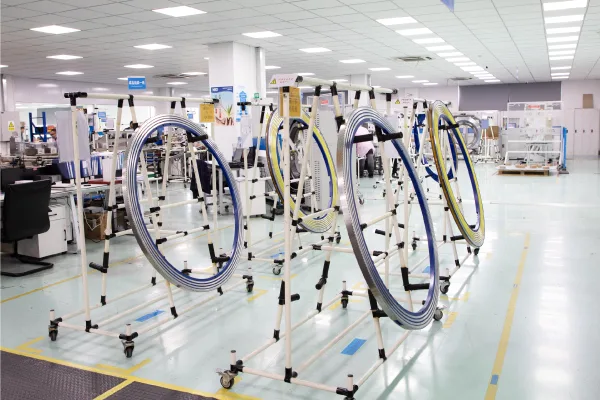
The slip ring benefits from the CT gantry spinning quickly and continuously. It powers the X-ray tube and sends data from the detector to the fixed processor frame by frame, so signals don't get lost. One of the most important parts of a scanner is the slip ring. It's also one of the hardest parts to change once the platform is up and running.
If you buy a CT slip ring from the wrong company, you'll have problems with dependability, image quality, and customer service. It will pay off for ten years if you choose the right company to supply your medical tools. Take the time to write down clear answers to these ten specific questions before you make a decision.
A: Credentials & Compliance
Before you look at any specs, make sure the seller can work with you as a medical-grade partner. Start with certifications and training. From there, everything else builds on top of those.
1. Does the supplier have proven medical industry experience?
There is a big difference between a company that sells industrial slip rings in general and one with a track record in CT. Don't just look for "medical" on a product page; ask for named CT programs, reference designs, and years of use in medical imaging. CT is a core vertical for established players. Some clearly position themselves as primary CT slip ring suppliers, while others offer medical lines with gantry-specific specs.
Ask for customer references, application case studies, and proof that the provider understands the limitations of gantry integration, such as large through-bore diameters, patient aperture clearances, weight budgets, and noise limits. General competence doesn't automatically translate to these needs.
2. Do they meet medical industry standards and requirements?
The main rules governing this group are ISO 13485 (quality management systems for medical devices) and the IEC 60601-1 family (safety and basic performance for medical electrical equipment). These are not just nice to have; they are necessary. Getting ISO 13485 approval from a parts provider matters because regulators monitor the entire supply chain. This can help you get into the market. This includes things like CE marking for EU MDR and FDA submissions.
Look at the details: If you want to buy something, make sure the certification covers what you need and that the IEC 60601-1 version on the certificate is up to date (3.2 at the time of writing). If a license is useless or out of date, you shouldn't keep it.
3. What quality control systems are in place?
Certification describes a framework; daily use tells you whether what arrives at your dock is good. For incoming materials, ask about in-process inspection checkpoints, lot traceability, and contact material specifications. For example, gold-to-gold contacts are a common choice for stable, low-noise signal transmission in medical settings. If a seller can't explain why they chose the materials they did, they haven't thought it through.
Also, ask how they handle nonconformances and corrective actions (CAPA), and what paperwork they produce. Ask for a sample first-article inspection report as a guide. Their QMS is clearer from the way it looks than from any leaflet.
B: Technical Capability
Credentials make a seller qualified. How well they work determines if they fit your scanner's data rate, shape, and speed range.
4. Can they support high-speed data transmission?
This is CT's most important technology issue right now. As there are more detector slices, more data moves from the spinning gantry to the stationary processor. At this speed, sliding electrical contacts can no longer handle the data reliably. Noncontact data lines, like optical, RF, or capacitive-coupled links, are now used by serious providers. These can handle throughputs of many gigabits per second without the noise and wear and tear of mechanical contact.
Take headline data-rate numbers as the vendor's best-case claims, and compare them to datasheets that have already been made public. Find out what kind of coupling method they use, how well it works at real working temperatures, and how it changes as the number of detector rows increases. The claim isn't just for sales; the answer should be clear and scientific.
5. Can they provide customized solutions?
Ready-to-use CT slip bands are hard to find. Most of the time, through-bore widths are greater than 1,000 mm. Power, data, fiber-optic routes, and sometimes gas or fluid lines must all be combined into one unit. Because the gantry has its own mounting shape, weight limits, and EMC shielding needs, it needs more customization.
Check with the supplier to see whether they have engineers on staff and are willing to work with you on both mechanical and electrical designs. Also, find out how they make and test prototypes. Ask how soon they can get active. If they don't show up until after you've frozen your system, they're not really a technical partner. They are just a list.
6. Can they provide complete technical data?
Datasheets, dimensional drawings, contact-life curves, insertion-loss and bit-error-rate data for data channels, EMC characterization, and test reports are all things that a reliable provider will give you. Not marketing speak, but real data that your engineers can use to make sure the design works and that your regulatory team can put in technical files.
Find out if they will help you with your verification testing by giving you raw measurement data and how they handle confidential information that an NDA protects. Treat any performance number given without supporting documentation as unreliable. That's the answer if a seller can't give you the paperwork.
C: Reliability & Manufacturing
A spec sheet says something will happen. Testing and production capacity show that the supplier can keep it for the life of your product and the number of units you need.
7. Do they have reliability and life-testing capability?
CT slip rings work almost all the time; they break down because of contact wear, dirt, and signal loss. Find out about accelerated life testing, rotational endurance rigs, environmental testing, and how they figure out service life and maintenance times (or say the machine doesn't need any).
Keep in mind that when manufacturers talk about life-span and performance testing, you should look into the real test methods and sample sizes. Takeaway: Ask for the MTBF/service-life methodology and proof, and ask how they ensure the integrity of the contactless data channel over the rated life.
8. Do they have the production capability to meet volume?
Prototype success is needed but not enough. Find out how much can be made, how long the wait time is usually, and how consistent each lot is. This is especially important for contact materials and precision mechanical parts where quality differences can directly affect performance. Ask how they handle important raw materials in their supply chain and whether they have a plan for a part that is hard to requalify mid-project.
The risk here is unique to CT because the slip ring has a long lead time and a high level of integration. A supplier that can reliably deliver prototypes but struggles with large orders creates a production bottleneck that impacts your whole scanner program.
D: Partnership & Support
It takes years to be in a CT slip ring relationship. The last two questions separate a vendor from a real client.
9. Do they support global customers?
Your slip ring provider should be able to help you worldwide if you ship scanners worldwide. Ask about international shipping, technical support in the area, paperwork in the languages needed, and understanding of the rules and regulations in the market where the product will be sold, such as FDA and CE certifications as well as market-specific ones when they apply.
Customers' downtime depends on how quickly you can get spare parts, how well you support installed scanners in all the areas you serve, and how many customers you have. If you do business worldwide, be wary of sellers who are strong in their home country but not elsewhere.
10. Can they provide long-term engineering support?
There are decades, not years, between CT platform service lives. The supplier you choose today should still be a working partner in year eight, supporting design changes, managing component obsolescence, keeping spare parts available, and providing named engineering contacts who understand how your integration works.
Find out how they let people know when an item is no longer being made, how long the interface and software will last, and how they handle old parts that won't work with newer products. Write down the promises of ongoing support. Pay close attention to how they react during the evaluation; that's the best way to gauge how the relationship will work under pressure.
The Bottom Line
If someone wants to be a medical-grade partner, they need to meet four criteria. These are credentials and compliance, technical capability, reliability and production capacity, and partnership. Technical capability shows who can meet your scanner's data, geometry, and speed needs; partnership shows who will still support your product in eight years.
When you factor in field failures, requalification costs, and scanner downtime, the cheapest CT slip ring maker isn't always the cheapest. If someone wants to sell medical equipment, they should be able to back up all ten of their answers with certificates, datasheets, test reports, and references, not just what they say in a sales pitch.
You can make a scorecard for your sellers with these ten questions. Your program's risk rating will tell you how much to weigh each area. To be honest, every answer should be backed up by proof. If a supplier ducks or can't answer a question, take that as proof in and of itself. You can learn a lot about the partnership from the replies.
NBG Innovations Group Pte.Ltd.
#13-13A, International Plaza, 10 Anson Road, Singapore (079903)


Navigation
 HomeSustainable
Product