


CT Slip Ring vs Traditional Cable System: Why Modern CT Scanners Use Slip Rings
BY NBG
 2026-09-04
VIEWS: 1314

CT Slip Ring vs Traditional Cable System: Why Modern CT Scanners Use Slip Rings
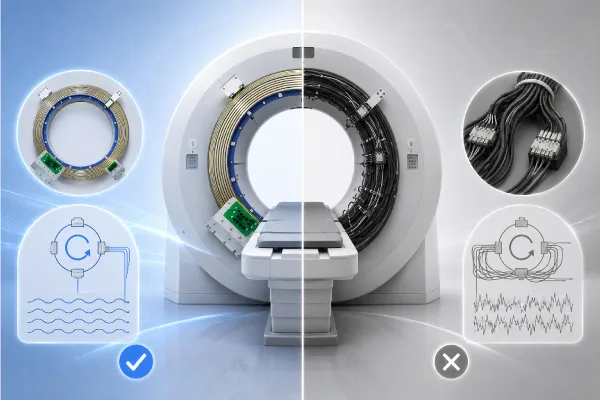
Every CT scanner has the same basic engineering problem: the X-ray tube and detector array must keep spinning around the patient. At the same time, it consumes kilowatts of power and transmits gigabits of image data. This has to happen across a live boundary between a still frame and a moving gantry.
For the first ten years of clinical CT, cables did that job. They did their job, but they also made it very hard for CT to do other things. Slip ring technology eliminated those restrictions, enabling helical (spiral) scanning, continuous rotation, and the volumetric imaging that doctors now take for granted. It's not even close: wires started CT, but slip rings defined its future.
From Cables to Slip Rings: A Short History of CT Scanner Technology
CT scanning didn't appear fully formed. The technology went through different stages, and each was limited by the electrical and mechanical systems available at the time. Knowing about the evolution and the exact moment slip rings came into play helps us understand why the change was so important and why no one has really tried to undo it.
The Cable-Bound Era: Sequential "Step-and-Shoot" Scanning
High-tension cables supplied power to the rotating X-ray tubes in first- and second-generation CT scanners. The plan worked. Still, it wasn't very flexible because wires can only be bent so far before they get tangled or wear out. To stop that from happening, the gantry turned in one direction to get a single slice, then stopped and turned around to go back to where it started before the next slice could start. This back-and-forth cycle—acquire, stop, rewind, and repeat—became known as "step-and-shoot" scanning.
This had major effects on patients' health. Because they acquired one slice at a time, they were slow. Patients had to hold their breath repeatedly for several acquisitions, and even small movements between slices caused problems. Structures that move quickly, like the heart, were mostly off limits. As long as the gantry was attached to something, continuous acquisition and scanning a large area of tissue were not possible.
The Slip Ring Breakthrough (1980s → Helical CT)
In the 1980s, slip rings were introduced into third-generation CT scanners, solving the cable-limitation problem. Slip rings join the moving and stationary frames without cables. They do this by mounting circular conductive rings on the rotor and stationary brush contacts that ride against them on the stator. The brushes maintain an electrical connection while the gantry spins, so no cable gets tangled and no rewind cycle is needed.
Right away, there was a steady, unending spin in one direction. Helicoidal (spiral) CT is now possible. The patient table moves slowly through the bore while the gantry keeps turning, spiraling through the body. It was now possible to record one breath-hold of the whole chest or belly. After its invention, most CT researchers consider the slip ring one of the most important changes in the technology's history.
Slip Ring vs Cable: A Head-to-Head Comparison
Slip ring and cable-based systems differ in every way that matters for CT performance, including how the gantry moves, how reliably it operates, how much data it can carry, and how often it needs service. The table below shows the key attributes. The following sections explain what each row means in real life.
Attribute | Traditional Cable System | Slip Ring System |
Rotation | Limited; must stop and reverse-wind | Continuous, unlimited single-direction |
Maintenance | High cable flexing, fatigue, tangling | Low sliding contacts or contactless, long service life |
Data Transmission | Limited by cable flex and length | High-speed (multi-Gbit/s), real-time |
Reliability | Lower; cable fatigue and multiple failure points | Higher, engineered for millions of rotations |
Rotation: Limited vs Continuous
This is what makes them different. Because the cables repeat the motion, the acquisition speed and mode can't go faster than that. Slip rings let the gantry spin indefinitely in one direction. This isn't just a convenience; it's required for all advanced CT acquisition modes used in clinical practice today.
Maintenance: High vs Low
Cables that bend over time get worn out and have known failure points. Slip rings are designed to last a long time. Contacting designs use strong brush and track materials to extend service intervals, while contactless designs eliminate slide wear. Compared with cable-based designs, both methods greatly reduce unplanned downtime.
Data Transmission: Limited vs High-Speed
A cable that has to bend with every turn can only handle a certain amount of signal bandwidth before it breaks down from the stress of the spin. Modern CT scanners, especially multi-slice and photon-counting systems, produce large volumes of data that can't be reliably transmitted over cables. Slip rings, especially contactless types, send real-time detector data across the rotating surface at speeds of several gigabits per second.
Reliability: Lower vs Higher
Slip rings are more durable than cables because they have fewer ways to break mechanically, are made of materials designed for them, and have designs tested over hundreds of millions of turns. That reliability margin is important in a medical setting where scanner downtime directly impacts patient care.
How Slip Ring Technology Works in a CT Scanner?
Slip rings solve two separate issues at the same time: they bring power into a system that is always turning, and they let high-speed data flow out of it. These are not the same engineering problems, and current CT systems often solve them differently on the same rotating interface, with one for power and one for data.
Power Transmission Across the Rotating Interface
On the power side, the rotating gantry (rotor) has evenly spaced conductive rings, and the brush contacts on the frame (stator) move continuously against them. Several kilowatts of power flow through this interface to power the X-ray tube, the anode cooling systems, and other rotating electronics.
Ring and track materials are usually copper or silver because they conduct electricity well and are durable. Brush materials are usually graphite-carbon composites or metal-fiber designs, chosen for their slow wear. Gantry rotation speeds in clinical CT systems are in the low to mid-hundreds of RPM. Check the manufacturer's service documentation to get the exact range for your platform.
Contactless Data Transmission: Capacitive and Optical
Detector data is increasingly moving across the rotating interface through contactless pathways rather than sliding contacts. The clear reason is that the noise level and bandwidth limits of sliding contacts become problematic at the data rates required by modern detectors. Image data is transmitted via capacitive (near-field microwave or RF) coupling and optical pathways, such as fiber optics or LED-to-photodetector links, with low noise and no sliding wear.
Many modern designs still use contacting ring tracks for power and lower-rate control signals. High-rate detector data, however, travels on a separate contactless path. This hybrid setup matches the signal's needs with the transmission method.
Why Do Modern CT Scanners Require Slip Ring Technology?
Slip rings are not just a new way to fix a problem that wires used to handle well. They enable the most useful features for doctors. Without continuous rotation, it would be physically impossible to achieve the acquisition modes, data volumes, and timing accuracy typical of current CT. It would not just be annoying; it would be impossible. All of the following improvements are impossible without slip ring technology.
Enabling Helical and Volumetric Imaging
You can't add helical CT to a step-and-shoot system because the gantry must rotate continuously. Slip rings meet that requirement. Helical scanning, cine imaging, 4D protocols, and cardiac gating are all common ways that doctors get images today. They all come back to the ability to rotate constantly. Without the slip ring, those modes will no longer work.
Meeting the Data Demands of Multi-Slice and Photon-Counting CT
As CT went from single-slice detectors to 4-, 16-, 64-, and finally 320-slice detectors, the amount of data passing through the rotating interface grew at the same rate. Photon-counting CT scanners, which measure each photon's energy rather than combining them, enable even higher data rates.
To keep up, slip rings have had to change to accommodate wider-bandwidth contactless lines and higher aggregate throughput. There is no good way to upgrade a cabled system in this case because the physics of a flexing cable imposes a limit that can't be circumvented.
Clinical Speed, Throughput, and Patient Safety
Technical capabilities directly affect clinical outcomes. Continuous rotation lets you take a single breath-hold image of the whole body, eliminating slice misregistration common in step-and-shoot imaging.
Motion artifacts decrease, image quality improves, and methods such as CT angiography, pulmonary embolism protocols, trauma surveys, and pediatric imaging that depend on precise timing work reliably. Higher scanner reliability and less maintenance work mean more uptime, which directly affects how many patients can get care and how quickly they can get it.
The Future of CT Slip Rings
In CT, the slip ring doesn't always play the same role. As detector technology improves, the spinning interface will have to do more work, and the slip ring must keep up. The part that made helical CT possible in the 1980s is very different from the mixed contacting-and-contactless assemblies used in photon-counting systems today, and the next generation will be even more different.
The path is clear: higher and higher contactless data rates, smaller, more modular designs, and dependability levels that work with the newest photon-counting and ultra-high-resolution systems. Higher per-channel and overall throughput goals than current production systems.
Conclusion
It's clear which is better. Cables made CT possible in hospitals, but they imposed strict limits on mobility, data flow, and long-term reliability. Slip rings solved all those problems and are now the base technology for modern CT scanners. They enable helical scanning, volumetric imaging, and the high data rates required by multi-slice and photon-counting devices.
As CT continues to work toward higher resolution and faster acquisition, the slip ring, which the patient can't see and which is often missed in clinical discussions, is still the most important part of the system that can't be replaced.
NBG Innovations Group Pte.Ltd.
#13-13A, International Plaza, 10 Anson Road, Singapore (079903)


Navigation
 HomeSustainable
Product