


Capsule Slip Rings for Gimbal and Camera Stabilization Systems
BY NBG
 2026-05-25
VIEWS: 819

Capsule Slip Rings for Gimbal and Camera Stabilization Systems
The cables on a 360°-spinning gimbal get twisted, which is a major problem. The wiring bundle gets a little tighter with each full turn until the insulation wears out, the connectors break, or the whole thing stops working. It isn't just a theoretical problem for camera platforms that never stop panning, like surveillance domes, drone payloads, and broadcast heads; it's a real mechanical problem.
Capsule slip rings can be used to fix it. These small electromechanical parts send power and electrical signals across a moving interface without any physical connection between the stationary and moving parts. Capsule slip rings differ from larger through bore designs because they are self-contained units that combine the stator, rotor, bearings, and housing into a single sealed body. They are small enough to fit in the smallest rotary platforms.
Capsule Slip Ring Construction and Operating Principles
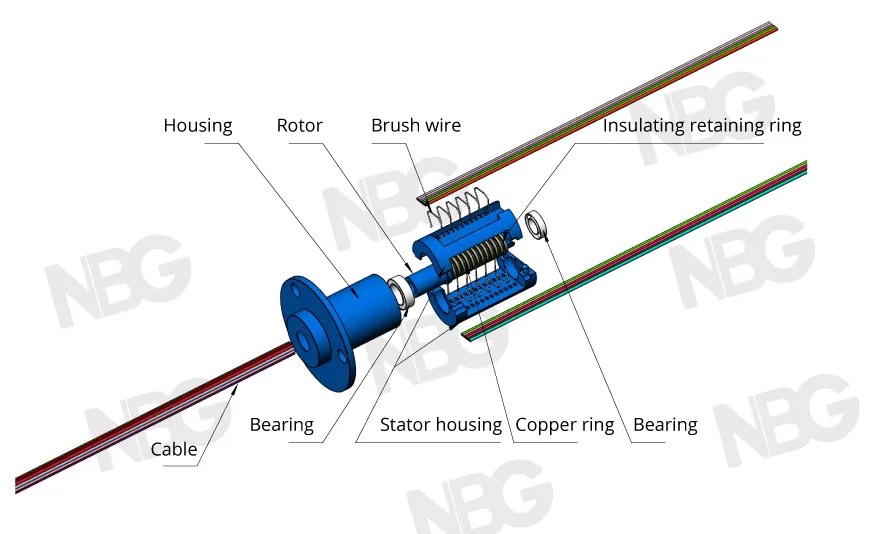
Before testing how well a capsule slip ring works in a gimbal system, it helps to know what the part is made of and how it sends electrical signals across a rotating interface. The choices made at this level affect everything from torque drag to signal quality.
Mechanical Architecture
A capsule slip ring has all of its moving parts inside a sealed cylinder, so there is no need for a hollow central bore. Most gimbal class units have outer diameters that range from about 6.5 mm to 25 mm. For loads that require many circuits, larger units can be 45-54 mm. The brush block and terminal leads that protrude from the housing at one end are on the stator, which doesn't move. The yaw (pan) axis of the gimbal moves the rotor, which holds the ring stack, made with great care. Two preloaded ball bearings keep things in line and can handle axial loads. Depending on the gimbal's shape, flange-and-shaft-mount setups can have cable exits that are either axial or radial.
Contact Technology
The contact interface of a slip ring determines how well it works. Gold-to-gold contacts are used in capsule designs for applications that are sensitive to signals. Both the brush tips and the ring surfaces are gold-plated, which prevents oxidation, reduces debris, and keeps resistance low over millions of revolutions. Most of the time, ring grooves are cut with a 90° V-profile so that the brush tip stays in contact with two surfaces at all times. It reduces bounce and changes in dynamic resistance. Multi-point brush assemblies have two or more brush contacts for each electrical circuit. They provide parallel redundancy, so if one contact lifts briefly due to vibration, the others maintain the connection. Under these conditions, dynamic contact resistance typically remains at or below 35 mω at 50 rpm.
Why Capsule Slip Rings Are Ideal for Gimbal Applications
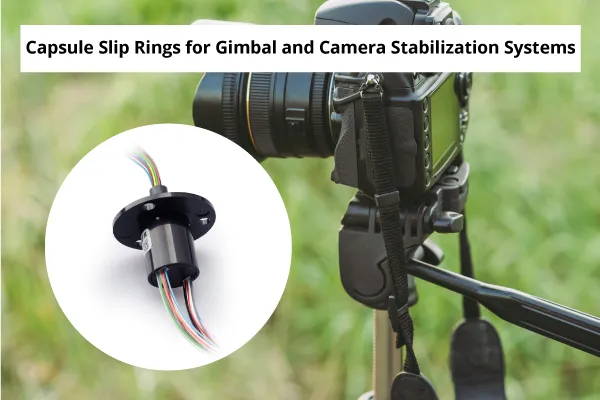
The basic design of a capsule slip ring is one thing, but its effectiveness with gimbal and stabilization systems depends on how its physical and electrical properties match what those systems require.
Compact Form Factor and Low Mass
UAV gimbals have a strict weight limit, and every extra gram means less flight time or less payload capacity. Small capsule units with an outer diameter of 6.5 to 12.5 mm fit between the yaw motor output and the camera platform without shifting the gimbal's center of mass. Handheld stabilizers have similar problems: excessive weight on the pan axis tires the operator and limits the motor's ability to compensate. A capsule slip ring features an integrated design that eliminates the need for separate bearing housings or external brush holders. It keeps the assembly mass lower than similar through bore designs.
Low Torque and Smooth Rotation
Stabilization algorithms need the motor to work the same way every time. Any friction introduced by the slip ring at the pan axis appears to be a problem the control loop has to deal with. If the friction changes, it's even worse because it's hard to model and eliminate. Capsule slip rings use precious metal brush systems carefully selected for low, steady starting torque. When used with precision preloaded bearings, well-designed units add only a few grams of drag per centimeter. It is within the resolution of the IMU-driven correction loop and well below the point where image stabilization starts to break down.
Low Electrical Noise
The video signal that passes through the slip ring is used in broadcasting and cinematography. When the brush ring contact makes electrical noise, it shows up as artifacts in the image. These can be interference patterns in analog outputs, CRC errors in digital streams, or timing jitter that causes frames to be dropped. Gold-gold contacts with advanced surface finishing can have noise floors as low as 5 mω, which work with HD-SDI and Ethernet transmission without requiring any extra filtering.
Signal and Power Transmission Capabilities
The mechanical properties of a slip ring are only important if it can also handle all the electrical signals and power loads the camera platform requires.
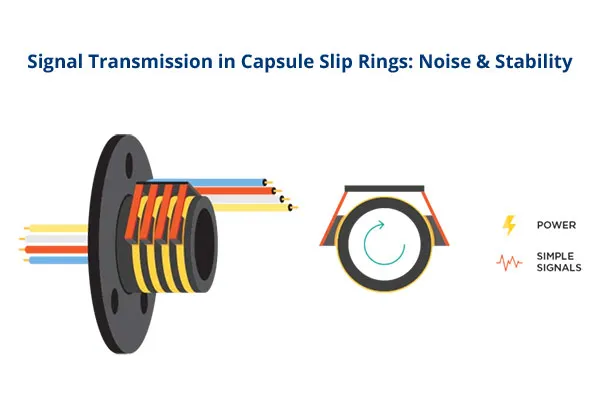
Video Signal Transmission
The rotating contact needs both bandwidth and phase stability for high-definition video. Capsule units made for HD-SDI can transmit signals at up to 3 Gbps and support 1080p and 1080i formats. They have coaxial internal routing and a characteristic impedance of 50 Ω. HDMI-integrated capsule models have the higher bandwidth and differential signaling that Ultra-HD pipelines need for 4K@30 Hz broadcast and cinema workflows. Professional units can have connector terminations in MMCX, SMA, or BNC formats, depending on the cable plant that follows.
Data and Control Protocols
Modern camera payloads can simultaneously send and receive data over multiple protocols, including video. Ethernet (100Base-T and 1000Base-T), USB 2.0/3.0, RS-485, RS-422, CANbus, and PWM lines can all fit in the same capsule slip ring for multi-circuit installations. Most compact gimbal payloads have between 6 and 18 circuits, but big multi-sensor platforms used for surveillance or robotic inspection may need 56 or more circuits. When gigabit data lines and 12 V or 24 V motor supply circuits are in the same box.
Power Distribution
The rotary interface needs to send DC power to the camera modules, focus actuators, and extra lights. Capsule slip rings can handle 1 to 2 A per channel in their signal circuits. Power rings in the same capsule can handle 5 to 30 A and send 12 V or 24 V to heavier loads without needing a separate rotary power coupler.
Application Domains
The table below summarizes the primary application domains, their specific technical demands, and the slip ring characteristics that address them.
Platform | What the Application Demands | Capsule Slip Ring Fit |
UAV / drone gimbal
| Minimal added mass; must survive airframe vibration and hard landings
| 6.5–12.5 mm OD units; MIL-STD-810E shock and vibration rating
|
PTZ surveillance dome
| Non-stop 360° pan rotation, often running 24/7 for a decade or more
| 50 million+ revolution service life; simultaneous HD-SDI, RS-485, and PoE on a single capsule
|
Cinematography and broadcast
| Zero tolerance for electrical noise reaching the video signal; pro cable interfaces required
| Gold-to-gold contact system; MMCX, SMA, or BNC terminations; HDMI-capable variants for 4K
|
Robotic inspection and LiDAR | Several protocols running at once, like vision, depth, control, and power, all crossing the same axis
| 56+ circuit configurations; CANbus, Gigabit Ethernet, USB, and PWM in a single housing
|
UAV and Drone Camera Gimbals
Capsule slip rings are mounted on the yaw axis between the airframe and the gimbal platform. It allows for continuous pan rotation without the need to manage cables. For applications with very tight axial envelopes, there are separate rotor-brush configurations. Vibration and shock resistance, as specified in MIL-STD-810E, is important here. Motor vibration, turbulence-induced oscillation, and hard landings all put mechanical stress on the slip ring that simpler designs can't handle in the field.
PTZ Surveillance Cameras
Speed dome cameras work continuously, moving quickly from one preset position to another at up to 360°/s while staying in place for extended periods. Through the same capsule, they simultaneously send HD-SDI video, RS-485 control data, and PoE power. A service life rating of 50 million revolutions means the bike can be used for normal duty cycling for 10 to 15 years. It is an important number for infrastructure installations where maintenance access is costly or limited.
Cinematography and Broadcast Rigs
Motorized remote heads for film and live broadcast need the least amount of electrical noise possible because the video signal goes straight to air or to a master recording. Professional RF connector options for HD-SDI and HDMI capsule slip rings work well with existing broadcast cable plants. When you need wireless control relay on a complicated multicamera rig, you can add RF rotary joints next to the capsule slip ring.
Robotic Vision and Industrial Inspection
LiDAR sensors and cameras mounted on robotic arms need to continuously rotate and send data back in real time over multiple protocols. AI-driven inspection payloads are increasingly combining streams from visual, depth, and thermal sensors. It requires many circuits and the ability to carry Gigabit Ethernet, along with analog and low-speed control buses, without mutual interference.
Selection Criteria for Gimbal Integration
The following parameters include mechanical, environmental, and electrical factors that must be checked before a unit is included in the design.
Mechanical and Environmental Parameters
The first limit is the gimbal envelope available. The outer diameter and axial length must be clear of motor housings, bearing plates, and any other nearby mechanical structures. The IP rating requirements depend on where the equipment will be used. For example, IP54 is enough for indoor stabilizers and studio equipment, but IP65 or higher is needed for outdoor drone payloads, cameras mounted on boats, and industrial installations that are likely to get wet or contaminated with particles. Standard units can work in temperatures from −20 °C to +60 °C. For airborne and Arctic applications, there are extended-range units that operate from −40 °C to +80 °C. Check the vibration and shock ratings against the platform's expected mechanical environment.
Electrical and Signal Integrity Parameters
Before choosing a unit, you should obtain the circuit count and per-channel current rating from a full-payload power budget and signal manifest. For circuits that carry video or sensitive sensor data, the dynamic contact resistance fluctuation should be set at ≤35 mΩ. When power and signal circuits share the same housing, they need to be at least 10 MΩ at 100 VDC and at least 100 V at 50 Hz to keep the channels separate. You should check that the bandwidth and data rate support work with the specific protocol versions you are using. Not all devices that claim to support Ethernet also support Gigabit speeds, and 3G-SDI needs to be explicitly checked.
Capsule vs. Through Bore
The capsule form factor is best for applications where mass, compactness, and signal sensitivity are most important and where there is no need for a mechanical shaft, fluid conduit, or optical fiber to go through the rotation axis. When the central bore needs to carry a physical element, such as a drive shaft, pneumatic line, or hydraulic circuit that works with the electrical circuits, through-bore (hollow-shaft) slip rings are the best choice. IEEE Spectrum has discussed the engineering trade-offs in multi-axis rotary systems in which both optical and electrical signals pass through the same interface. When neither form factor is enough on its own, hybrid configurations that combine a capsule slip ring for electrical circuits with a fiber-optic rotary joint (FORJ) for optical channels meet this need.
Conclusion
Capsule slip ring technology has steadily advanced towards smaller outer diameters, higher bandwidth thresholds, and extended certified operational lifespans, driven primarily by the demands of UAV payloads, broadcasting infrastructure, and AI-integrated inspection platforms. The result is a type of component that used to be a niche specialty but is now a standard part of any rotating camera system that needs to send data faster than simple brush on wire setups can handle.
To choose the right unit, you need to compare three mostly separate sets of specifications: the mechanical envelope and environmental rating, the signal protocol and bandwidth, and the power budget, with what the platform really needs. As capsule slip rings improve, with hybrid capsule-FORJ modules and multi-protocol designs ready for AI sensor-fusion payloads, the number of options continues to grow. It makes systematic specification matching more important, not less, as the number of options grows.
NBG Innovations Group Pte.Ltd.
#13-13A, International Plaza, 10 Anson Road, Singapore (079903)


Navigation
 HomeSustainable
Product