


Capsule vs Pancake Slip Ring: Which Is Better
BY NBG
 2026-05-27
VIEWS: 793

Capsule vs Pancake Slip Ring: Which Is Better?
When picking the right slip ring for a small rotating system, the capsule and the pancake are usually the two most important form factors. Both transfer power and electrical signals across a rotating interface, but they do so in very different ways. The difference in geometry is what accounts for almost all the performance differences between them.
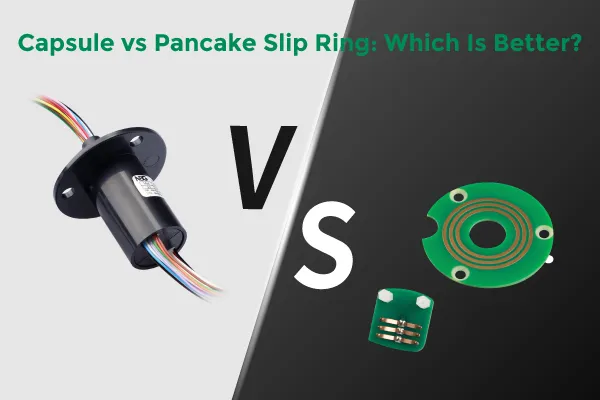
The capsule design features conductive rings stacked along a central shaft in the axial direction, forming a drum shape. Instead, the pancake design places conductive tracks in concentric circles on a flat disc perpendicular to the rotation axis. There is no one best architecture. The best one for you will depend on the mechanical envelope, rotational speed, signal quality needs, and extended maintenance budget of your application.
This article goes over architectural differences, compares performance directly, offers guidance for specific applications, and provides engineers with a practical way to decide which configuration to use from the start.
Understanding the Two Architectures
Before comparing performance, it's important to know exactly how each design is made. It is because the geometry of each format drives all the trade-offs that follow.
What Is a Capsule Slip Ring?
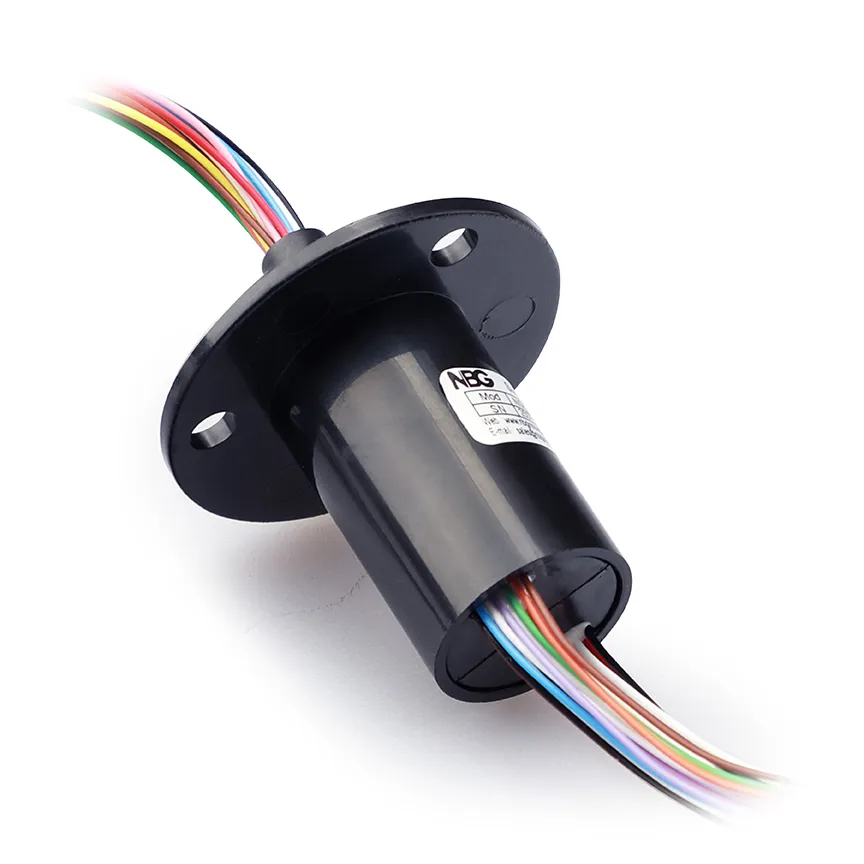
A capsule slip ring is a small, cylindrical electromechanical device with conductive rings stacked along a central rotating shaft. As more circuits are added, the device gets longer along its axis, but its outer diameter remains about the same, usually between 5.5 mm and 55 mm, with circuit counts ranging from 2 to 56 or more.
The contact interface typically uses a gold-on-gold or gold alloy brush for the ring contact, which helps keep contact resistance low and stable. Fiber brush types from companies like Moog and NBG can last for more than 50 million revolutions because they virtually eliminate wear debris. The housing is closed, and precision ball bearings support the shaft. Insulation rings keep each conductor apart.
Capsule slip rings, which are also called miniature slip rings or compact slip ring capsules, are the most common type of slip ring used in both business and industry.
What Is a Pancake Slip Ring?
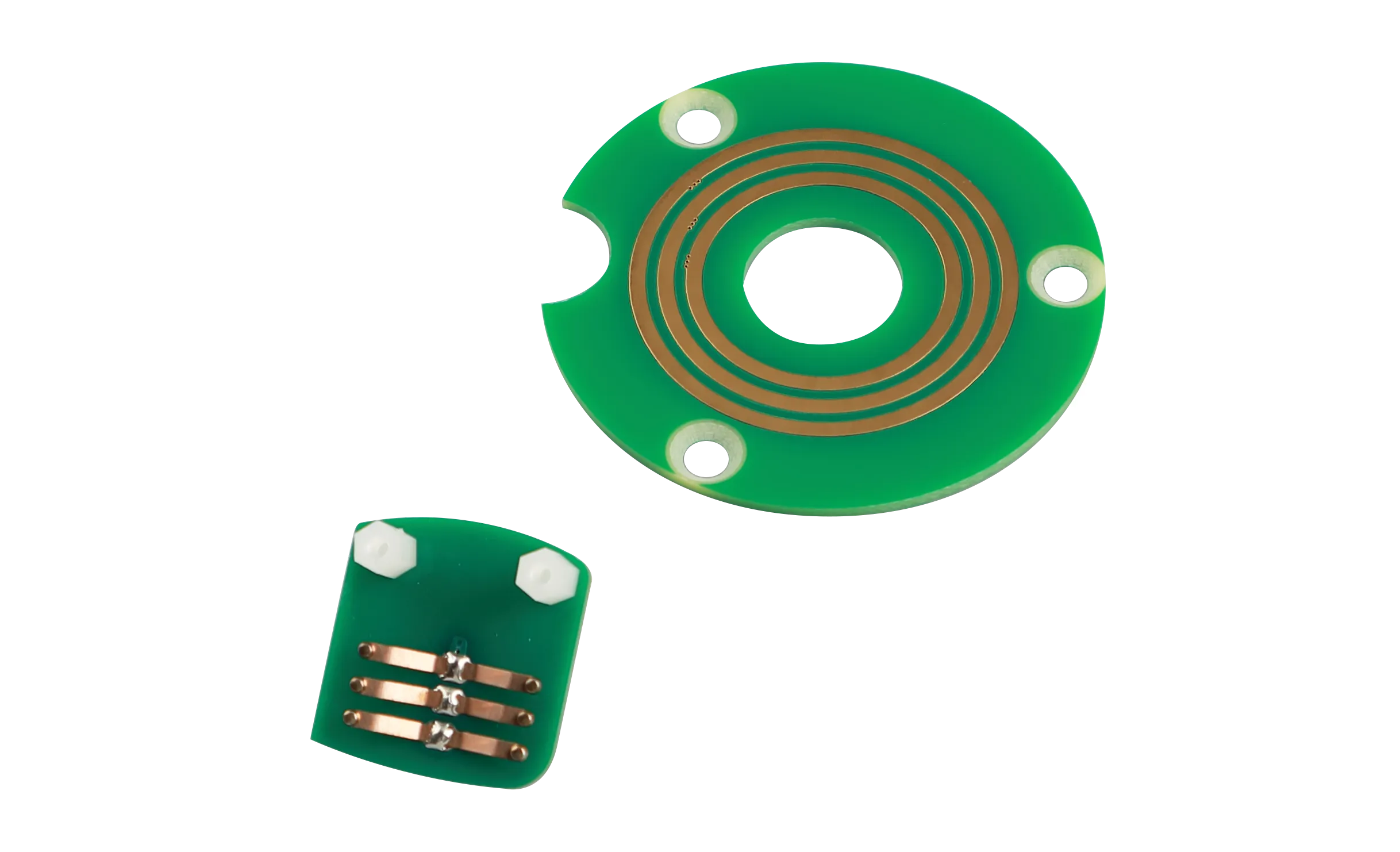
A pancake slip ring, also known as a flat slip ring, platter slip ring, or disc slip ring, has conductive tracks arranged in concentric circles on a flat rotor disc that turns at right angles to the axis. The stator plate is right above or below, and leaf brushes with springs press down on each track.
Because of this shape, the axial profile is very low. Ultra thin PCB based pancake versions can be as short as 5.8–6 mm. The trade-off is diameter: each additional circuit ring increases the disc's outer diameter. It can be anywhere from 50 mm to over 500 mm, depending on how many circuits there are. Most setups use gold-gold or silver-silver contact materials. These can handle 2 to 48 circuits with current ratings of 5 to 20 A per ring.
Head-to-Head Performance Comparison
Once both architectures are defined, you can compare them based on the most important criteria in a real specification: available space, operating speed, signal quality, and maintenance burden.
Dimensional Envelope and Space Trade Offs
The most important geometric fact is that adding circuits to a capsule makes it longer along its axis, while adding circuits to a pancake makes it wider along its radius. A capsule with 24 circuits will have a body that is longer than its diameter. In a pancake configuration, the same number of circuits keeps the height low, maybe even less than 10 mm. However, the disc can reach 200 mm or more in diameter.
So, the decision driver is easy: figure out which dimension is limited. The pancake wins if axial depth is the most important factor. If the radial envelope is tight, the capsule is the best choice.
Rotational Speed Limits
In standard setups, capsule slip rings can usually handle speeds between 250 and 400 rpm. In high-speed versions, they can reach 1,000 rpm or more. The brush contact force remains constant across the entire ring surface due to the cylindrical shape. It helps the ring run smoothly at high speeds.
Most pancake designs can only go around 200 to 300 rpm. Because the outer rings move faster than the inner ones at any given rotational speed, the radial brush geometry creates more friction on the outer rings. It accelerates wear and limits practical speed limits. The capsule is better than other items, such as robotics, radar pedestals, and precision test equipment that require rapid spinning.
Signal Integrity and Electrical Noise
In a capsule design, rings that are separated along the axis naturally lower inter-circuit capacitance and crosstalk. Capsule slip rings are great for sending high-frequency data, like Ethernet up to 1 Gbps, USB, RS-485, CANbus, and RF signals. In terms of both crosstalk and capacitance, drum-type (capsule) designs usually do better than pancake designs.
The concentric rings in a pancake are very close together on the same radial plane. This closeness increases the capacitance between circuits, making the design more susceptible to electromagnetic interference. It is a big problem for applications that need a lot of data or high-frequency signals.
Contact Wear, Debris, and Maintenance
When brush contact occurs, wear particles fall off the ring surfaces under gravity and don't accumulate at the interface. It occurs on a capsule slip ring oriented along a horizontal axis. Fiber brush technology goes even further, producing almost no debris. It makes the device easy to care for and gives it a long, predictable lifespan.
Pancake designs have a structural maintenance problem. When brushes press down on horizontal ring surfaces, wear debris falls directly onto the contact tracks. The outer rings wear brushes faster than the inner ones because they move faster and feel more centrifugal force. It causes uneven brush wear and shorter maintenance intervals. It means that operating costs will be higher in the long run.
Current Capacity and Delivering Handling
Standard capsule slip rings can handle about 2 A per circuit, but larger ones can handle 10–50 A per ring. This range can handle anything from sending signals only to sending a lot of power, all in the same small housing.
The ring's width limits the current capacity to about 10–15 A per ring, so pancake configurations are mostly used for signal transmission. Motorized stages, heavy industrial actuators, and multi-axis robots are examples of applications that require high-power transfer over long periods. In these cases, a capsule or a through-bore slip ring is usually a better choice.
Application Specific Selection Guide
Performance data shows the strengths of each format, but the best way to use that information is to look at where each design has already worked in real life.
Where Capsule Slip Rings Excel
The capsule is the best choice for a wide range of systems because it has a small radial footprint, can quickly send and receive signals, and maintains strong signal strength. Some common uses include CCTV and PTZ cameras, speed dome surveillance systems, drones and UAVs, industrial robots, rotary test equipment, medical instruments (such as endoscopes and dental handpieces), rotary tables, and stage lighting rigs.
The capsule's lower crosstalk characteristics make it useful for any system that sends structured data protocols, such as Ethernet, USB, RS-485, CANbus, or FireWire. The capsule is also better for systems that need to stay up for a long time and can't be easily maintained because it has a longer brush life and doesn't get dirty.
Where Pancake Slip Rings Excel
Pancake designs are best for situations where axial height is the main mechanical limit and speed or signal needs aren't too high. A classic example of a pancake application is the steering column systems in cars, especially multifunction steering wheels that can switch between different modes. Flat shapes also work well with cable reels, rotary doors, microwave turntable mechanisms, and slow-speed servo drives.
Split-center pancake designs with bore diameters of 500 to 1,000 mm are used in large-bore industrial applications like reclaimer equipment, offshore cranes, and large rotary indexing tables. No cylindrical capsule can match this scale.
Cost and Lifecycle Considerations
When it comes to making capsule slip rings, they are usually cheaper to make and more cost-effective when made in large quantities. Even though the initial cost of a simple pancake assembly may be a little higher, its longer operational life, especially when fiber brush technology is used, lowers the total cost of ownership.
In some ways, pancake designs are harder to make. For example, precision electroplating of concentric ring tracks requires tight tolerances, and the system requires more maintenance, which increases lifetime costs.The drum (capsule) designs are usually more cost-effective and work better than pancake designs in most situations.
Decision Framework for Choosing the Right Type
The table below condenses the selection logic into a step-by-step reference:
Selection criterion | Favours capsule | Favours pancake |
Constrained dimension | Radial (tight OD envelope) | Axial (very low height needed) |
Rotational speed | Above 300 rpm | Below 200 rpm |
Signal type | High-frequency data, Ethernet, RF | Low-frequency signals, switching states |
Current per circuit | Up to 50 A (larger variants) | Up to ~15 A |
Maintenance access | Limited; long life preferred | Routine access available |
Bore requirement | Small or no bore | Large bore (up to 1,000 mm) — pancake or through-bore |
Total cost of ownership | Lower over service life | Higher due to maintenance frequency |
No one type is better than the other. The right answer is always based on the application. If neither a capsule nor a pancake fits the mechanical envelope, especially if a large hollow bore is needed along with moderate speed and signal requirements, a through-bore (hollow-shaft) slip ring may be a better third option.
Conclusion
For most small rotating applications, capsule slip rings are preferred because they support higher rotational speeds, better signal quality, longer service life, and lower cost. Their axially stacked design works well with many circuits, prevents dirt buildup, and can handle high-frequency data protocols that pancake designs struggle with.
Pancake slip rings remain a good, well-designed option when axial height is the main concern and the application runs at moderate speeds with simple signal requirements. They are not inherently inferior; they are specifically designed for a particular envelope.
Before choosing either configuration, design engineers should map out the entire mechanical envelope, specify the electrical requirements for each circuit, and determine how often the product will need to be serviced over its lifetime. Talking to slip ring manufacturers early in the design process, before the enclosure geometry is set, can save you money on redesigns and ensure that the configuration you choose is the best for the job.
NBG Innovations Group Pte.Ltd.
#13-13A, International Plaza, 10 Anson Road, Singapore (079903)


Navigation
 HomeSustainable
Product