


Common Causes of Slip Ring Overheating
BY NBG
 2026-03-30
VIEWS: 2184

Common Causes of Slip Ring Overheating
Slip rings are supposed to work all the time, even under tough duty cycles and when thermal stability is very important. In reality, heat is one of the biggest threats to long-term performance. Overheating is not only a sign of electrical or mechanical problems that are already present, but it also accelerates brush wear, breaks down insulation, and creates a cycle of rising resistance followed by even more heat generation. The first step in stopping something is to know what caused it in the first place. This article discusses the six main causes of thermal failure that engineers should consider when designing and maintaining systems.
Elevated Contact Resistance at the Brush–Ring Interface
How I²R Losses Generate Heat
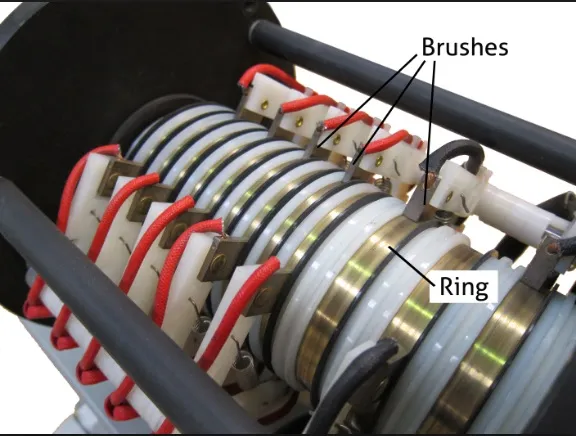
In most slip ring assemblies, the brush–ring interface has the most contact resistance, which is the main source of electrical heat. The relationship is simple: power loss follows P = I²R, meaning that even a small change in resistance can cause a large change in heat output. As the interface gets worse, heat buildup gets worse on its own. Resistance increases as temperature rises, and the resulting heat makes it even hotter.
This resistance usually increases when the surfaces that contact each other oxidize, accumulate dirt, or develop micro-pitting from repeated arcing. Dust, carbon particles, and oil movement all make it harder for electricity to flow smoothly. These pollutants degrade the contact area over time, creating hot spots in some areas.
Key Contributing Factors
A common reason is that the brush materials are worn out or don't match. A standard carbon-graphite brush, for instance, may not work well in a high-speed application, whereas silver-graphite or precious-metal composites are better suited. Improper brush seating is another problem. If there isn't enough pressure, the brush will only contact the surface sometimes, and if there is too much pressure, friction and wear will increase. Surface contamination, ring grooves, and scoring reduce contact uniformity and increase interface resistance.
Overcurrent and Electrical Overloading
Operating Beyond Rated Current Capacity
Most of the time, slip ring current ratings are given at an ambient temperature of about 25°C. That assumption is often not followed in real installations. As the temperature rises, the ability to carry current must decrease. If the assembly continues to run at full load without being derated, resistive losses increase, and heat builds up quickly.
If the conductors, brush cross-sections, or plating thicknesses are too small for the job, electrical overloading can happen. When the current exceeds the planned ampacity, the excess energy is converted to heat at the contact path and conductor terminations.
System-Level Overload Scenarios
When motor drives work at higher than rated torque, they often pull more current through the slip ring assembly than expected. Multi-channel designs can also get too hot if the power and signal circuits share conductors with too small cross-sections or if the spacing between channels limits how quickly heat can escape. In many systems, the weak point isn't the ring body itself; it's the lead wires that are too small or the terminations that aren't crimped well enough, which add series resistance and create hot spots. Violations of the duty cycle are also important. Running the unit continuously at peak load generates much more heat than using it only when needed, as it was designed for.
Inadequate Ventilation and Sealing Constraints
The Role of Airflow in Heat Dissipation
Many slip ring designs use natural convection as their primary cooling mechanism. If a unit is put inside a small or poorly ventilated space, the heat has nowhere to go. The structure around it acts as a thermal trap, causing the temperature inside to rise even when the electrical load stays within nameplate limits.
It is very important for sealed installations. IP65 to IP68 protection enclosures keep dust and moisture out, but they also block airflow. That sealing might be necessary, but it needs to be done on purpose by spacing, heat sinking, or active cooling.
Installation and Enclosure Failures
Common installation problems include blocked vents, insufficient space around the assembly, and installing it in a small machine cabinet without forced-air support. Another big problem with high-current systems that need active airflow to work at their best is when the cooling fan stops working. The way the slip ring is mounted and its proximity to other heat-producing devices, such as VFDs, motors, and power supplies, can also raise the ambient temperature above the slip ring's design limits.
High Rotational Speed and Frictional Heat
Friction as a Thermal Source
As the RPM increases, the brush–ring interface becomes a larger source of frictional heat. As the sliding speed, brush force, and the coefficient of friction between the contacting materials increase, thermal generation increases too. Even when the electrical load is low, the rotation speed alone can raise the interface temperature.
Most standard slip rings are rated for temperatures below 80°C, but in high-speed applications, they can quickly exceed that limit without any special design changes. As the temperature rises, the brushes wear out faster, and contact stability worsens. It can cause more arcing and localized thermal spikes.
Speed-Related Design Failures
Problems usually happen when standard brush materials and shapes are used in places where precious-metal fiber brushes or designs with less contact force would work better. If the balance is off and the runout control isn't good enough, vibration can occur, leading to intermittent contact and short bursts of arcing. If the assembly wasn't made to handle long-term thermal stress, not having heat-resistant insulation or housing materials can make things worse if it runs at high speeds for a long time.
Elevated Ambient Temperature and Harsh Environmental Conditions
How Ambient Conditions Affect Thermal Headroom
The thermal headroom of a slip ring is the difference between the temperature at which it can safely operate and the ambient air temperature. That margin gets smaller as the temperature around it goes up. A unit that works fine in a controlled plant setting may overheat quickly in a foundry, test cell, or outdoor installation that is closed off.
Most standard assemblies can work in temperatures between –20°C and +60°C. In industrial and specialty settings, the upper limit can be much higher, leaving little room for heat generated inside.
Environmental Thermal Stressors
High humidity speeds up oxidation on ring tracks, raising contact resistance and making things even hotter. Radiant heat from nearby machines, such as kilns, induction systems, or heat sealers, can increase the thermal load in ways not specified in the original specs. Choosing the right materials is also very important. When the temperature goes above the rating, standard thermoplastic insulators may soften or change shape. In high-temperature service, PTFE or ceramic-based insulators may be needed instead.
Poor Lubrication and Mechanical Friction
Lubrication Breakdown as a Thermal Driver
Bearings and brush assemblies need the right amount of lubrication to keep friction between moving parts low. When lubrication isn't enough, is dirty, or isn't specified correctly, friction and heat generation go up. In very bad cases, surfaces start to work with little or no protective film, which speeds up wear and tear.
This risk is even higher in places with high temperatures, where regular greases can oxidize, evaporate, or lose their viscosity. When the lubricant film breaks down, the bearings and other parts near them may start running on metal-to-metal.
Specific Failure Mechanisms
Over-lubrication and under-lubrication can both cause things to get too hot. Too little grease makes things stick together, and too much grease makes things churn, which also makes heat. Contaminated lubricant can introduce abrasive wear particles into bearing raceways and brush mechanisms, further increasing friction coefficients. Another common cause is misalignment between the rotor shaft and housing. It can place excessive radial load on the bearing set, causing localized thermal stress.
Recognizing Early Warning Signs of Thermal Distress
Overheating of a slip ring usually occurs gradually until it becomes a visible failure. One of the first signs is a measurable increase in voltage drop across the slip ring circuit, indicating that the contact resistance is increasing. Infrared thermography can also show hot spots on brush holders, ring tracks, and termination points before the damage to the insulation becomes clear. A burning smell, a change in surface color, or blackening around brush assemblies are other warning signs. More electrical noise could indicate an unstable contact or arcing caused by thermal expansion. You should also take abnormal vibration seriously because changes in size due to heat can affect balance, alignment, and bearing preload.
Prevention and Resolution Strategies
Preventing overheating begins with careful design and a realistic review of how the application will be used. When choosing brush materials, conductor cross-sections, and plating, you should base your choices on the actual duty cycle, not just peak load assumptions. Engineers need to check the manufacturer's thermal rise data at the expected current and RPM, not just the ratings in the catalog.
You might need active cooling, such as forced air, heat sinks, or liquid cooling, for systems that use a lot of power or are in a confined space. Using built-in thermocouples or online IR sensing to monitor temperature continuously gives you an early warning before damage worsens. Brush inspections, four-wire Kelvin resistance checks, and regular thermal scans should all be part of maintenance programs. The enclosure's design should also strike a good balance between keeping things out and letting heat out.
Conclusion
There is usually more than one reason why a slip ring overheats. Most of the time, it happens because of stressors in the environment, on the machine, and in the electrical system that build up over time. Engineers can prevent most thermal failure modes by considering contact resistance, current loading, ventilation, speed, ambient conditions, and lubrication as a whole system. Before you finish making any high-power or high-speed rotating assembly, obtain thermal-rise test data and duty-cycle-matched specifications from your slip ring supplier.
NBG Innovations Group Pte.Ltd.
#13-13A, International Plaza, 10 Anson Road, Singapore (079903)


Navigation
 HomeSustainable
Product