


Common Issues In CT Slip Rings And How to Fix Them CT
BY NBG
 2025-07-24
VIEWS: 3974

Common Issues In CT Slip Rings And How to Fix Them CT
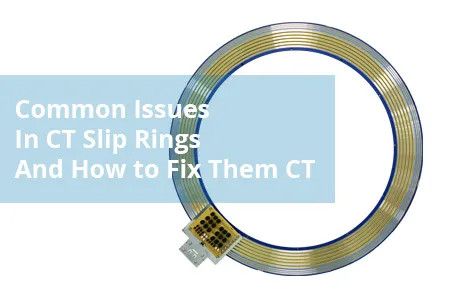
CT slip rings help to ensure continuous power and data transfer during gantry rotation in CT scanners. However, over time, some issues, like mechanical wear and contamination can cause the system to fail. This article explores these issues and diagnostic methods to ensure long-term operation.
Typical Failure Modes
Some of these failures can happen slowly, while others can cause the scanner to stop immediately.
Arcing
One of the most common CT slip ring issues: arcing. Arcing can happen for multiple reasons: design flaws such as inexperienced manufacturers selecting inappropriate insulation materials or insufficient spacing; poor carbon brush holder design causing dust accumulation in dead zones; or insufficient spring pressure leading to brush bounce.
With 12 years of slip ring design experience, NBG knows how to mitigate arcing risks structurally.
Other cases show manufacturing process issues or quality control lapses in some brands — tiny copper strands inside the CT can pose significant arcing risks.
External factors can also cause arcing — oil leaks from the tube cooling system or voltages exceeding the slip ring’s rated value.
How to prevent arcing? The simplest measures are: choose an experienced, proven slip ring brand, perform thorough reliability testing, and conduct regular maintenance. These steps significantly reduce the risk of arcing failures.”
Wear & Tear
Wear is the most common issue in CT slip rings. The friction between the brushes and the ring causes the metal to wear down over time. After a while, the contact becomes significantly weak, causing signals to drop or stop. This can also cause the scanner to pause or show errors.
Signal Loss or Communication Errors
A CT slip ring receiver typically has three indicator lights. If a light fails to illuminate, it indicates a data transmission fault.The simplest first step is to replace the receiver. If data transmission is restored, the issue is resolved. If not, the problem may lie in the transmitter, antenna, or upstream data source, requiring professional inspection and repair.
Causes can vary: inexperienced manufacturers may skip proper EMC testing, receivers or transmitters may have poor quality control, or soldering issues may cause weak connections.
Preventing data loss involves three key steps: select a proven, experienced slip ring brand; perform rigorous reliability testing; and maintain the system regularly. Long-term neglect can lead to carbon dust spreading inside the CT, affecting the slip ring antennas.
Overheating
Too much heat can also cause the scanner to fail. Heat builds up when there is more current than the ring can handle, the cooling fans aren’t working properly, or ventilation issues when the airflow inside the gantry is blocked.
Even a small increase in temperature can cut the life span of slip ring parts by half. Thermal expansion can also loosen internal parts, which may lead to vibrations or unstable contact points during scans.
Control Signal Data Dropout
This failure can be caused by corrosive gases like hydrogen sulfide in the air reacting with the slip ring tracks, or disinfectants affecting the tracks, leading to uneven or high resistance.Another cause is using carbon brushes not designed for the specific CT slip ring. For example, NBG brushes are engineered for all storage, transport, and operational conditions of spiral CTs. Non-certified brushes may suffer from bounce, dimensional mismatch, thermal expansion, uneven resistance, short life, or improper spring pressure.
Preventing control signal dropout: choose an experienced, proven slip ring brand, use certified brushes, and perform regular maintenance. When issues occur, track polishing blocks can also be used to smooth slip ring surfaces — contact NBG sales for more information.
Contamination & Corrosion
“The final common issue is contamination and corrosion. Over time, dust, moisture, and fine particles — especially carbon dust from brush wear — accumulate on slip ring tracks and may disperse to other areas.
Hospitals near polluted areas may have hydrogen sulfide in the air, which corrodes copper tracks. Disinfectants used in regular cleaning can also be corrosive. These factors can lead to metal corrosion and slip ring failure.
Without regular cleaning and maintenance, arcing, insulation failure, and communication errors can occur. Follow the maintenance manuals provided by experienced slip ring manufacturers to ensure long-term stable and reliable operation.”
Diagnosis Checklist
Finding these problems early is necessary to minimize the scanner downtime, and it also saves time and money. The table below shows how to detect these issues before the ring fails.
Inspection Type | What To Check | Common Indicators |
Visual & Mechanical | Look closely at the brushes and ring surface. Check for brush length, contact angle, and signs of burning. | Pitting, scratches, dark spots, dust buildup, or the brushes not touching the ring evenly. |
Electrical and Signal Testing | Measure the resistance between the ring and brush. Check for signal noise or insulation breakdown during rotation. | High resistance usually greater than 1 ohms, unstable readings, waveform spikes, and dropped signal data. |
Runout control | Use a dial indicator to check the runout of the slip ring. | The reading on the dial indicator exceeds the limit |
Environmental & Usage Context | Look around the scanner and check room conditions for exposure to dust and moisture. Also, check air filters and house seals. | Wet spots and dirty vents. |
Preventive Tips
Regular Maintenance Schedule
CT slip rings should be cleaned regularly and inspected to ensure continuous operation. A regular schedule helps to spot signs early and prevent the system from unexpectedly shutting down. Systems that scan all day need more frequent checks than the ones that are used a few times a week.
Cleaning & Lubrication
Use compressed air to clear out loose debris and dust that builds up inside the slip ring housing. A soft cloth with mild solvent can be used for mild surface cleaning.
Also, if there are signs of pitting, use non-metallic abrasive pads for light sanding.
Runout control
A dial indicator should be used to check the slip ring runout during the assembly of CT scanning equipment.
Environmental Controls
The environment of the scanner also matters a lot. Air filters in the room and in the system should always be cleaned to keep dust and moisture out. The gantry closings should have the right IP ratings as well.
Repair VS Replacement
When to Repair
If brushes are worn out, but the ring surface is still clean, it is best to simply change the brushes. Rings with shallow surface marks can be resurfaced with a bit of light sanding. Small signal issues usually come from dust buildup or surface oxidation, and both can be fixed with simple cleaning or re-seating.
When to Replace
If the ring shows deep pitting, burn marks, or cracked insulation, then replacement is the best option. Parts that overheat or have melted plastic could pose a fire risk. If signal errors continue even after cleaning and adjusting, it could be because of internal damage, which means the rings need to be replaced.
Cost, Availability & System Criticality
Facilities should also consider how many scans are delayed each hour that the machine is down. A hospital or clinic will lose more from downtime than from replacing a part early. If replacements are to be done, check if the parts can be found locally or how long it will take to ship.
Service Cycle Guidance
Recommended Maintenance Intervals
The maintenance of a CT slip ring depends on how much the system is used. For high-use systems like CT scanners, they wear down faster because they are used on a daily basis. Therefore, it’s best to inspect them more frequently, like every 3 months.
On the other hand, systems that are used intermittently can go longer between checks. They can be inspected every 6 to 12 months, depending on how much they are being used. Some systems also come with built-in counters for scan cycles, and those numbers can be used to plan the service properly.
Documentation & Trend Analysis
Always write down detailed logs during each inspection. Keep track of brush length, temperature readings, and signs of wear. Over time, these logs help to detect any anomalies early on, which can be fixed, and they prevent emergency downtimes.
Advanced Diagnostics
Invest in automated slip-ring testers and use them when possible. They can be used to test resistance, signal clarity, and noise. They give reliable data and reduce human error during testing, ensuring a standardized maintenance routine. Some of them can also be connected to laptops to store past readings, making it easy to compare over time.
Conclusion
CT slip rings wear down with time, heat, and use. Regular checks, cleaning, and smart part replacement keep scanners running safely. These small steps help to prevent major breakdowns in the long run.
NBG Innovations Group Pte.Ltd.
#13-13A, International Plaza, 10 Anson Road, Singapore (079903)


Navigation
 HomeSustainable
Product