


How Capsule Slip Rings Achieve Low Torque and Stable Rotation
BY NBG
 2026-05-07
VIEWS: 1034

How Capsule Slip Rings Achieve Low Torque and Stable Rotation
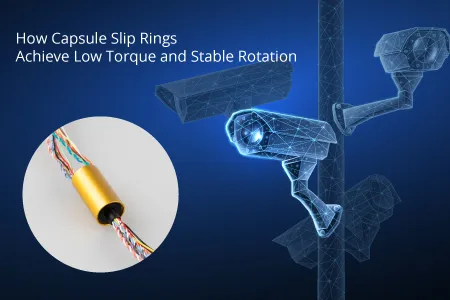
A capsule slip ring is a sealed, self-contained electromechanical rotary connector that transmits electrical power and signals between a stationary and a moving structure. The capsule format differs from open-frame or through-bore formats because it includes rotor rings, brush assembly, bearings, and protective housing, all in a single engineered unit that can be installed directly into small mechanical assemblies.
In systems with limited space, such as robotic joints, CCTV pan-tilt heads, UAV gimbals, medical instruments, and rotary indexing tables, even small amounts of starting torque or rotational instability can have significant effects. Low torque and stable rotation in capsule slip rings are not coincidental results. They come from planned design decisions that change the shape of the contact, the chemistry of the contact material, the mechanics of the brush spring, the choice of bearing, and the accuracy of the housing dimensions.
Anatomy of a Capsule Slip Ring
To understand how a capsule slip ring gets low torque, you need to know how it is built. The way its parts are put together and how they work together directly affect the rotational resistance of the assembly.
Integrated, Sealed Construction
The most important thing about the capsule format is its sealed, self-contained structure. The rotor (conductive ring stack), stator (brush block assembly), precision ball bearings, and outer enclosure are all manufactured and assembled as a single unit. Standard outer diameters range from about 6.5 mm in super-miniature versions to 54 mm in high-density multi-circuit assemblies.
The number of circuits in a single capsule body can be anywhere from 2 to 56 or more. For light, low-load jobs, engineering plastics are used. For general industrial use, aluminum alloy is used. For jobs that require chemical exposure or a high IP rating (IP68), stainless steel is used.
Key Dimensional and Performance Parameters
The table below summarizes the typical specification range for precision capsule slip rings used in motion-critical applications:
Parameter
| Typical Range |
Outer Diameter | 6.5 mm – 54 mm |
Circuit Count | 2 – 56+ |
Working Speed | 0–300 rpm (standard); up to 6,000 rpm (high-speed variants) |
Rated Current per Circuit | 1 A – 30 A |
· Operating Temperature | −40 °C to +80 °C |
· Protection Grade | IP54 – IP68 |
Electrical Noise | ≤ 10 mΩ dynamic resistance fluctuation |
Service Life | 5M – 30M+ revolutions |
Dynamic resistance fluctuation, which is the change in contact resistance that happens when something rotates, is one of the most important parameters for signal-carrying circuits. Keeping this below 10 mΩ for the service life is the standard that sets precision capsule designs apart from cheaper ones.
Engineering Variables for Drive Rotational Resistance
A classical mechanical relationship governs torque in a slip ring brush contact system:
T = F × R × μ × N
T is the starting torque, F is the brush spring contact force in gram-force, R is the radius of the ring track, μ is the coefficient of friction at the contact interface, and N is the total number of brush contacts in the assembly. The practical implication is straightforward: each variable constitutes a controllable design parameter.
The capsule format's biggest structural advantage is that it reduces the rotor radius (R). A smaller ring diameter means the moment arm is shorter for every friction force when the brush touches the ring. You need to be very careful when balancing brush count (N) and spring preload (F). When the brush bounces during rotation, it causes dynamic resistance spikes and signal dropouts.
Contact Geometry — How V-Groove Ring Design Enables Smooth Rotation
One of the most important choices in slip ring design is the shape of the contact surface between the brush and the ring. A ring with a carefully designed shape lowers both starting torque and long-term wear in ways that a flat contact surface can't.
The 90-Degree V-Groove Profile
Most precision capsule slip rings have a 90-degree V-groove cut into the conductive ring, rather than a flat contact surface. This choice of shape has a big effect on both torque and long-term stability.
The V-groove prevents the brush from moving in both axial and radial directions, making mechanical alignment easier. Even if the brush moves a little along its axis while it is turned, it will stay centered as long as it fits in the groove. The self-centering effect directly reduces the variation in contact force over the whole rotation cycle. The main way V-groove geometry keeps dynamic contact resistance below 10 mΩ is through this.
The groove also spreads contact stress over a larger effective surface area than a flat ring with only one point of tangential contact. It reduces wear and prevents dirt buildup in the sealed enclosure. CNC machining and very tight tolerances for surface finish are used on ring track surfaces. It lowers the microasperity-induced friction at the Hertzian contact scale.
Contact Materials with Gold-Gold Technology and Why It Matters for Low Friction
The quality of contact is not only determined by geometry; the material at the brush-ring interface is also very important. The type of contact material determines the friction coefficient, its resistance to oxidation, and the stability of the electrical connection after millions of rotations.
Why Gold Is the Preferred Capsule Slip Ring Contact Material
Gold contacts are standard in precision capsule slip rings due to tribological and electrochemical considerations. Gold has almost no oxide film formation across its entire operating temperature range. The surface of gold can change shape at the micro-contact level to fit micro-asperities without making abrasive wear particles. The slip ring contact interface has a coefficient of friction of about 0.15–0.20, which is much lower than that of copper, silver alloy, or carbon alternatives. Gold-on-gold contact pairing (with gold plating on both the ring surface and the brush tip) stops galvanic interactions between different metals.
The measurable result is that gold-gold contacts in capsule slip rings show a change in dynamic resistance of 10 mΩ or less over their entire operational life. When surface films form, unplated or carbon-brush systems often show resistance changes of 100 mΩ or more.
Fiber Brush Technology — Extending Gold Contact Advantages
Metal fiber brush bundles, usually made of a gold-silver alloy and with fiber diameters of about 100 microns, improve gold contact chemistry by spreading the brush-ring interface across Hundreds of parallel tip contacts in each circuit.
Bearing Selection and Mechanical Precision with The Structural Foundation of Stable Rotation
If the shaft that holds up the contact interface goes out of true, even the most carefully designed one will wear out. The mechanical foundation that keeps the brush-ring relationship stable throughout its service life is composed of the bearing selection and the housing tolerances.
Integrated Precision Ball Bearings
Capsule slip rings already have tiny precision ball bearings inside the housing, so they don't need any external shaft support in most low radial load applications. When the ring surface moves in relation to the brush tip during rotation because of too much axial or radial runout, the contact force and dynamic resistance change.
Miniature ball bearings with ABEC 5 or ABEC 7 ratings provide the radial play needed to keep runout within acceptable limits for applications that require positional accuracy and continuous rotation, such as robotic joints and rotary indexing tables. The capsule housing has sealed bearing cartridges that are pre-lubricated, allowing the device to run without maintenance.
Applications Where Low Torque and Rotational Stability Are Non-Negotiable
The design principles discussed above deliver performance benefits across a variety of challenging real-world systems. The following applications show why even small changes in starting torque and rotational stability can have a big effect.
CCTV Pan-Tilt Surveillance Systems
Pan-tilt camera heads can rotate continuously at a slow speed by 360 degrees, thanks to small stepper or DC geared motors operating within a very tight torque budget. A slip ring that adds even 5 to 10 g·cm of resistive torque can stop or mess up the drive mechanism at the speed it was told to go. For this type of application, gold-gold capsule slip rings with a starting torque of 5 mN·m or less are standard.
Collaborative Robotic Arms (Cobots) and AMRs
Cobot joint slip rings must simultaneously send encoder signals, CAN bus data, and servo power, without losing any signals or adding extra friction that could affect the baseline accuracy of the joint torque sensor. For 6-DOF robot arms with wrist and elbow joints, capsule slip rings with an outside diameter of 12.5-22 mm, fiber brush contacts, and gold rings are best.
Medical Instruments and C-Arm Fluoroscopy Equipment
Examination lights and C-arm rotation systems must rotate smoothly and predictably in both directions across the full arc of travel. Changes in starting torque lead to positioning errors that could put patients at risk. IP54-rated or higher sealed capsule slip rings prevent disinfectant sprays and airborne particles from entering.
Small Wind Turbines and Rotary Indexing Tables
Low starting torque is very important for small wind turbine yaw and slip ring generator applications. The turbine rotor needs to start turning at low wind speeds, and resistive drag lowers the effective power curve. Capsule slip rings that send 2 to 6 circuits of low-power control signals in 12.5 mm OD formats add almost no frictional drag. Rotary indexing tables need the same level of accuracy.
Specifying a Low Torque Capsule Slip Ring with Key Parameters for Design Engineers
Selecting a capsule slip ring based solely on circuit count and rated current is a common and consequential oversight. The following parameters must be reviewed at the specification stage:
● Starting torque specification: The manufacturer should not only give the operating RPM, but also the starting torque in mN·m. The maximum RPM rating doesn't tell you anything about the resistive torque that the drive mechanism is working against.
● Contact material confirmation: Check that the gold-gold pairing is correct on both the ring surface and the brush tip.
● The maximum profile: Set the V-groove ring geometry so it self-centers and doesn't drift laterally during rotation.
● Brush technology: For applications with dynamic resistance ≤10 mΩ and a service life of>5 million revolutions, fiber brush assemblies are the best choice.
● Bearing runout specification: Ask the manufacturer for the highest radial runout value, which is very important for applications that run at more than 100 rpm.
● IP rating vs. torque trade-off: Elastomeric lip seals make the drag torque easier to measure. Set IP54 as the lowest level, IP65 where fluids could get in, and IP67/IP68 only where there is a real risk of immersion.
● Mounting concentricity: Ensure the installation instructions state that the rotor is driven concentrically. Off-axis loads that pass through the bearing increase the torque and accelerate raceway fatigue.
Conclusion — Precision by Design, Not Coincidence
Several interlocking design mechanisms work together to make capsule slip rings stable and easy to turn. This aensuretor radius is driven that reduces the moment arm of brush friction forces; V-groove ring geometry that provides self-centering contact and spreads contact stress; gold-gold contact pairing that prevents oxidation-driven resistance instability while lowering the friction coefficient; and integrated precision ball bearings that control runout and separate the contact interface from externally imposed radial loads.
For the assembly to work reliably over its intended service life, each of the Several design variables must be matched to the application's torque budget, rotational speed requirement, and signal type. The capsule slip ring becomes a truly transparent part of the mechanical system when all variables are set correctly.
NBG Innovations Group Pte.Ltd.
#13-13A, International Plaza, 10 Anson Road, Singapore (079903)


Navigation
 HomeSustainable
Product