


How Multi Channel Fiber Optic Slip Rings Work (1–48 Channels Explained)
BY NBG
 2026-01-14
VIEWS: 1698

How Multi-Channel Fiber Optic Slip Rings Work (1–48 Channels Explained)
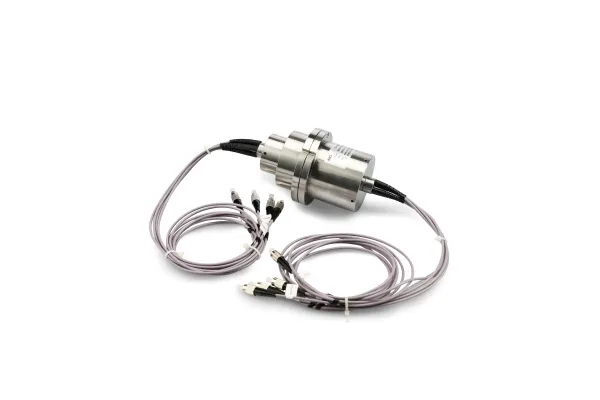
Multi-channel Fiber Optic Slip Rings (FORJs) are important components for transmitting high-bandwidth data at a rotating interface. Understanding their architecture is essential for designing advanced electromechanical systems.
Understanding Fiber Optic Rotary Joints (FORJs)
These are optical versions of electrical slip rings, specifically tailored to transmit light signals rather than electrons. FORJs are an essential connection that enables continuous data flow in applications that require full 360° rotation. Their major advantage is their ability to transmit gigabit data rates over long fiber lengths with minimal signal decay.
Basic Working Principle
The working principle is to carefully align the stationary and rotating fiber optics so that the light signal can pass through an optical interface gap with minimal loss.
The lens or prism system collimates the light beam, guides it through the gap, and refocuses it onto the output fiber. This ensures minimal insertion loss and high data integrity in a rotating state.
Key Performance Metrics
Metric | Description | Typical Values / Notes |
Insertion Loss (IL) | Optical energy is lost at the joint. | 0.5–3 dB |
Return Loss (RL) | The degree to which light reflects in the fiber. | Higher values indicate better performance |
Wavelength Compatibility | Supported operating wavelengths. | 850 nm, 1310 nm, 1550 nm |
Rotating Speed Capabilities | Maximum rotational velocity supported by the FORJ. | Ranges from hundreds to thousands of RPM |
Wow and Flutter | Variation of insertion loss during rotation. | Lower values indicate better stability |
Channel Configuration: From Single to 48 Channels
The number of channels determines the complexity of the FORJ's internal optical path, which in turn affects its cost, size, and performance.
Low Channel Count (1–4 Channels)
They are single-axis rotational systems with simple, robust designs. They frequently use spatial multiplexing, in which all the beams of light are slightly offset to avoid interference. Such models are found in small radar systems or simple robotic joints.
Medium Channel Count (6–12 Channels)
More compact, more complex optical routing is required in this range, using small lens arrays and micro-prisms. The biggest problem is keeping the channel spacing tight and avoiding signal leakage or crosstalk. Such a figure is typical for large industrial robots and remotely operated underwater vehicles (ROVs).
High Channel Count (24–48 Channels)
To realize 24–48 channels, state-of-the-art optical engineering is necessary and relies on technologies such as high-density lens arrays. These are complicated machines frequently constructed as concentric ring structures. They are used where high performance is required, such as in large military radars or high-end medical imaging systems.
Multi-channel System Optical Design Architectures
A multi-channel FORJ is characterized by the optical architecture, which determines its performance limits and physical size.
Prism-Based Designs
Prism systems are suitable for applications with medium to large numbers of channels, as they can achieve beam steering and superposition within a compact structure. This design redirects the channel beam through a precision prism, and its inherent stability and relatively low insertion loss are highly favored.
Lens Array Systems
To achieve the highest channel densities, lens-array systems are used, in which each fiber uses tiny precision lenses. These arrays focus and collimate light for multiple channels simultaneously. Their main strength lies in their compactness, although tolerances must be extremely tight to prevent crosstalk.
Off-Axis vs. On-Axis Configurations
On-axis designs pass channels through the axis of rotation, providing rotational symmetry and simplified mechanics. Off-axis designs use channels around the center to clear the area required for an electrical slip ring. Off-axis designs are less flexible and need more complex mechanical or optical compensation.
Technical Challenges in Multi-Channel FORJs
Breaking these barriers is important for reliability and signal integrity in critical long-term applications.
Optical Alignment Precision
The biggest challenge is maintaining micrometre-level optical alignment. Small fiber cores require that the light beam be coupled with extremely low deviation across the interface. More loss variation (wow and flutter) occurs due to bearing eccentricity or vibration.
Crosstalk Management
Crosstalk occurs when a signal from one optical channel leaks into an adjacent channel, corrupting data. High-quality anti-reflective coatings and optimized optical components are required to maintain maximum isolation between closely spaced paths.
Thermal Stability
Changes in temperature cause thermal expansion that disturbs optical positioning and increases insertion loss. Manufacturers address this by using materials with matched coefficients of thermal expansion (CTE) and by implementing specialized thermal management.
Real-Life Applications by Channel Count
The number of channels in any FORJ is closely tied to the data requirements of its application.
Defense and Surveillance Systems
High-channel-count FORJs are crucial for radar systems, defense equipment, and surveillance platforms. They transmit multiple high-resolution video streams and control signals simultaneously on a rotating platform, requiring reliability and low latency.
Medical Imaging
Medium to high-channel FORJs (6–12 and 24 or more) are used in CT scanners to transmit large volumes of raw image data at high rotational speed. The signal must be extremely stable for diagnostic image quality.
Industrial Automation and Wind Turbines
Large-scale wind turbines and industrial machines may use low to medium-channel FORJs (1–4 and 6–12), depending on the data requirements, when high-speed optical sensing is required. The main concern is durability and survival in harsh environments.
Broadcasting and Entertainment
FORJs support professional broadcast cameras on mobile platforms with high-definition video feeds. Medium-count channels ensure multiple uncompressed video, control, and timing signals flow without interruption during rotation.
Multi-Channel FORJ Selection Criteria
● Bandwidth and Data Rate Required: Determine whether you need single-mode (maximum bandwidth and longer distance) or multi-mode (shorter distances and easier coupling).
● Operating Environment: FORJ should withstand the operating temperature, vibration levels, and ingress-protection (IP) requirements of the application.
● Physical Constraints (Size/Weight): Determine whether the installation space can accommodate a larger prism-based system or requires the smaller footprint of a lens array.
● Lifetime and Maintenance: Review the stated rotational life and the anticipated maintenance interval required for high-precision components.
Conclusion
The multi-channel Fiber Optic Slip Ring is a critical component for systems that require high-speed data transmission across a rotating interface. They can precisely control complex optical pointing, minimize crosstalk, and use clever architectural designs to reliably transmit the large data volumes required by state-of-the-art applications. These include deep-sea exploration and high-resolution medical diagnostics.
NBG Innovations Group Pte.Ltd.
#13-13A, International Plaza, 10 Anson Road, Singapore (079903)


Navigation
 HomeSustainable
Product