


How to Reduce Signal Loss in Fiber Optic Slip Rings
BY NBG
 2026-01-14
VIEWS: 1992

How to Reduce Signal Loss in Fiber Optic Slip Rings
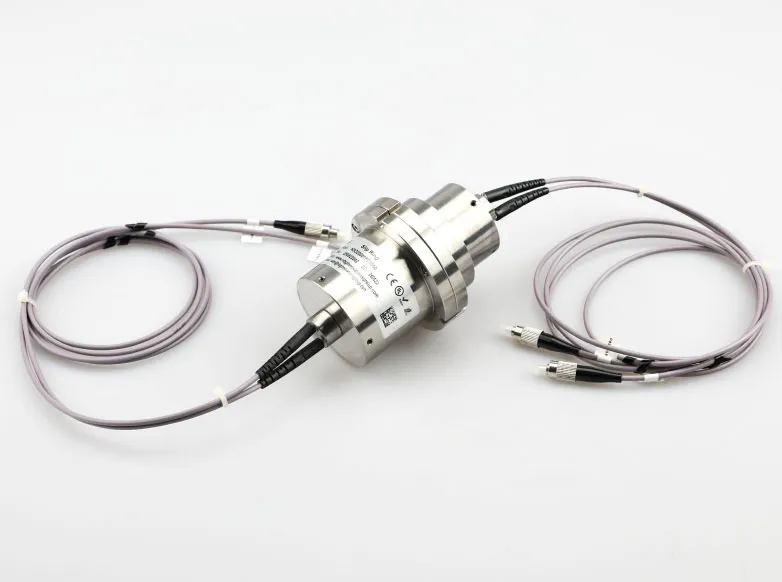
The smallest inefficiencies in fiber-optic slip rings can disrupt communication in the most essential application areas, such as industrial automation, medical equipment, and aerospace systems. This guide discusses effective measures to reduce losses and enhance the overall performance.
Signal Loss in Fiber Optic Slip Rings
Signal loss occurs when optical power is attenuated as it passes through the slip ring. An understanding of the causes would enable engineers to develop systems that are highly efficient in transmission.
What Causes Signal Loss?
Misalignment, contamination, low-quality fibers, or environmental factors such as vibration or temperature changes typically cause signal loss. Rotating interfaces are more complicated because even minor angular displacements will deflect light or enhance reflections at mating surfaces. Early intervention will decrease the problems in the long run.
Typical Loss Values
High-quality slip rings typically have an insertion loss of 0.5–3 dB/channel, depending on design and application requirements. The complexity of high-speed applications or multi-channel applications can also lead to slightly increased losses. Monitoring the system's performance and meeting its requirements can be achieved by tracking these values.
Material Selection and Optical Component Quality
The selection of proper materials and components has a great effect on signal integrity. High-quality fibers, lenses, and a robust housing minimize attenuation and ensure good performance across different conditions.
High-Grade Optical Fibers
Premium fibers are designed with core and cladding structures that are precisely controlled to reduce dispersion and scattering, and to reduce the number of modes. Low-attenuation fiber has higher signal strength and greater coupling between the stationary and rotating parts.
Precision Collimators and Lenses
The collimators combine and focus light with very precise control. Minimal-aberration lenses provide optical alignment, reduce insertion loss, and maintain signal consistency. Optical geometry is also exact, ensuring maximum efficiency across all channels.
Housing Materials
Housing materials are stable enough not to deform when stressed or vibrated, or subjected to changes in temperature. The structural integrity of metals and engineered composites depends on the fibers and lenses remaining aligned over time. Long-term reliability is also underpinned by durable housing.
Precision Alignment Techniques
Any slight misalignment may lead to huge signal loss. Correct alignment procedures during assembly are essential for ensuring good optical performance.
Active Alignment During Assembly
Active alignment involves optical feedback on component positions. Refinement is performed by tilting until the maximum signal output is obtained. This is done to ensure that the insertion loss is low at the beginning. All channels have high coupling efficiency.
Mechanical Design for Stability
Strong mechanical frameworks reduce movement caused by rotation or external forces. Alignment is maintained in low-runout bearings, stiff mounts, and stable layouts. These characteristics minimize threats of signal degradation in the long run. Mechanical stability is very important for repeatable performance.
Self-Centering Mechanisms
Small alignment deviations are self-centered. Even with rotation, optical paths remain constant. Signal fluctuations are reduced in dynamic conditions. This guarantees steady and good performance in the long term.
Contamination Control and Environmental Protection
It is necessary to protect optical surfaces from foreign contaminants to reduce signal loss. Some of the features and their functions are common and are highlighted in the following table:
Feature | Function | How It Reduces Loss |
Sealed Enclosures | Shield internal optics against dust and water. | The scattering and absorption that weaken signal quality are prevented. |
Connector Cleanliness Procedures | Removes debris and oils from fiber contacts. | Has clean interfaces, minimising reflections and insertion loss. |
Environmental Barriers | Insulate parts against heat and vibration. | Reduces stress-induced microbending and misalignment. |
Advanced Design Features
Innovative designs have been employed to minimize losses and enhance the reliability of systems by developing modern slip rings. A combination of these features improves maintenance performance and efficiency.
Multi-Channel Redundancy
● Parallel optical paths: Improve system reliability by keeping data flowing even if one channel fails.
● Automatic switch-over mechanisms: Reroute traffic to backup channels when the primary path fails, reducing downtime and maintaining signal quality.
● Per-channel loss monitoring: Detects early degradation, enabling proactive maintenance and preventing unexpected failures.
Index-Matching Technology
● Optical gels and fluids: The interfaces between the fibers may be filled with optical gels or optical fluids to minimize the number of reflections and enhance coupling efficiency by matching refractive indices.
● Minimization of air gaps: Minimizing air gaps reduces scattering and Fresnel reflections, thereby reducing insertion loss along optical paths.
Wavelength Optimization
● Appropriate wavelengths to be used: The ability to choose the right wavelength minimizes the internal attenuation and maximizes signal transmission efficiency of certain types of fiber.
● Multi-wavelength systems (Wavelength Division Multiplexing - WDM): WDM technology can transmit signals of different wavelengths on the same optical fiber, achieving a significant increase in data throughput without the need for additional optical fibers.
● The properties of loss at different wavelengths: Different wavelengths exhibit different attenuation characteristics, which help determine the optimal operating window and guide fiber and source selection.
Maintenance and Long-Term Performance
It is important to practice maintenance to keep signal loss low and system reliability high over time. The introduction of regular routines provides the optimal performance of optical parts.
Regular Inspection Schedules
Periodic checks reveal wear and tear, contamination, or misalignment before they affect functioning. Optical and visual inspection provides a fast solution to potential issues. Proactive solutions ensure high signal quality. This avoids unforeseen failures that might interfere with operations.
Preventive Maintenance
Fiber contacts cleaning, mechanical parts lubricating, and assemblies recalibrating. The measures reduce insertion loss and increase long-term reliability. Regular preventive maintenance ensures slip rings remain in optimal condition. It also reduces the time wasted and the cost of expensive replacements.
Life Cycle Management
Monitoring of usage, exposure to environmental factors, and component aging will enable prompt replacement of parts before they break. To maintain optimal optical performance, life-cycle management will be effective. It hedges investments in top-quality slip rings. Scheduled replacement helps prolong the system's life while remaining efficient.
Conclusion
Preventing signal loss in fiber-optic slip rings involves attention to materials, high-accuracy alignment, contamination control, and maintenance. Implementing those best practices ensures high-quality, effective, and sustainable optical performance across all applications.
NBG Innovations Group Pte.Ltd.
#13-13A, International Plaza, 10 Anson Road, Singapore (079903)


Navigation
 HomeSustainable
Product