


Using Through Hole Slip Rings in Cable Reels
BY NBG
 2026-06-23
VIEWS: 250

Using Through-Hole Slip Rings in Cable Reels
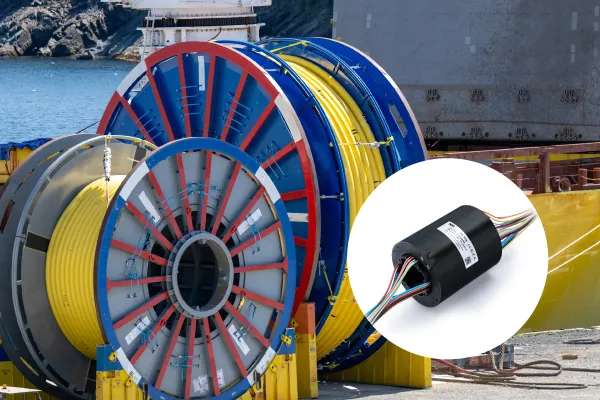
Cable reels need to keep turning to pay out and pull in cable, but a fixed electrical connection would twist, tangle, and eventually break. The through-hole slip ring is an electromechanical device with a hollow shaft that keeps power and signals flowing continuously as it spins 360 °. The hollow center bore allows the reel's central shaft, hydraulic lines, or cable harness to pass straight through the assembly, making it easier to connect the parts. This article discusses through-hole slip rings, where they are used, how to choose the right one, and how to keep them working.
What Is a Through-Hole Slip Ring and How Does It Work?
Core Operating Principle
The hollow bore has conductive rings around it that move with the reel drum. Stationary brushes with springs maintain sliding contact at all times. The brushes or rings turn, depending on how they are attached. The stationary part is connected to the power/signal source that doesn't move. Allows power circuits, analog and digital control signals, and high-speed data (Ethernet, CAN bus, RS-422) to be sent simultaneously across the rotating interface without the cables getting tangled.
The Hollow Bore Advantage
The axle shaft, internal cable harness, or pneumatic/hydraulic lines of the reel may all easily pass through the central bore, which varies from 12.7 mm to over 980 mm depending on the series. It reduces wiring strain by eliminating the need for intricate exterior cable management. The outer sleeve is secured in place by a threaded connection, a flanged bracket, or a torque support arm, while the inner sleeve encircles the rotating shaft.
Mounting Configurations for Cable Reel Applications
Internal Mounting (Central Axis)
A slip ring is positioned in the center of the reel along the axial direction, and the winding drum is positioned horizontally. The most compact configuration; ideal for small industrial reels with a predetermined number of conductors. Ideal for reels with fixed cable specifications that don't change frequently
External (Side Axial) Mounting
The slip ring is often housed in a protective box and fastened to the reel's side axially. It works best when several cable types are frequently utilized or when multiple cable types share a single reel. Changing brushes and maintaining the reel without disassembling it is made simple by the modular architecture.
Mounting Cantilevers
The drum protrudes from the cantilever section, and the slip ring is located at the bottom of the assembly. Larger systems that can accommodate long, heavy cables and require more space around the reel are better suited for this design. It is frequently seen in large industrial equipment, such as port machinery, where cables must travel great distances.
Mounting type | Main advantage | Best fit |
Internal / central axis | Compact layout | Standardized industrial reels |
External / side axial | Easier servicing | Reels with changing cable setups |
Cantilever | Better clearance for heavy cable | Large industrial and port equipment |
Key Industries and Applications
Material Handling — Cranes and Hoists
Because they allow cable reels to continue supplying electricity while the trolley moves back and forth down the runway, through-hole slip rings are frequently seen in overhead cranes, gantry cranes, and hoists.
Some large container-handling cranes operate at voltages as high as 24 kV for very high-power drives, and high-current variants can transport 100 A or more under challenging circumstances.
These assemblies can simultaneously transmit control signals and encoder feedback, which simplifies the wiring system as a whole.
Equipment for Mining and Construction
Tower cranes, excavators, drilling rigs, and open-pit mining machines are examples of mining and construction equipment that use motor-driven cable reels with slip-ring assemblies. Their role is to prevent long-distance trailing power and control wires from twisting or wearing out excessively.
Spring-driven reels with through-hole slip rings are not only helpful for transportable equipment without a permanent power connection, but they also allow the cable to be pulled out while the equipment is operating and then automatically rewound by spring force.
Certain applications require motor/torque motor drive systems, suitable for medium-to-long stroke operations and moderate loads, such as workshop overhead cranes and small-to-medium port machinery.
Hysteresis/variable frequency control is typically required for high-speed, long-distance, and high-precision synchronization applications such as quay cranes, stacker cranes, and automated production lines.
Application Scenario Recommendations
Cable reels are essential winding devices that provide power, control power supply, or signal transmission for mobile equipment, enabling efficient operations across various industries. They are widely used in ports, heavy industry, metallurgy, mining, construction, automation, energy, shipping, and stage production sectors. Below are their primary application scenarios and representative equipment:
1. Port and Logistics Handling (Core Application) Container Handling: Terminal cranes, yard cranes, gantry cranes, and tire cranes require long-distance, high-speed power supply during operation.
Bulk cargo handling: gantry crane, ship loader, ship unloader, stacker-reclaimer.
Dock operations: rail-mounted container cranes and grab crane systems.
Logistics storage: Automated automated vertical warehouse stacker cranes and AGV transfer system.
2. Metallurgy and Steel Industry (High Temperature and Heavy Load) – Steelmaking/Continuous Casting: Continuous casting machines, mold vibration systems, ladle trolleys, and roller conveyor trolleys.
Hot rolling/cold rolling: rolling mill, coiler, stepping beam, overhead crane/bridge crane.
Raw material processing: blast furnace feeding, sintering machine, and stockpile stacker-reclaimer.
3. Mines and Construction Machinery (Adverse Environments) Mining Operations: Mining excavators, loaders, underground hoists, and open-pit electric shovels.
Tunnel/Infrastructure: Shield machine, tunnel boring machine, dam top gantry crane, hydraulic hoisting and lowering equipment.
Construction machinery: Tower crane, construction hoist, material distributor, crawler crane.
4. Industrial Automation and Production Lines in Automotive Manufacturing: Mobile Power Supply for Welding Lines, Painting Lines, Assembly Lines, and Conveying Lines.
5. General Manufacturing: robotic workstations, flexible production lines.
6. Ship and Offshore Engineering Deck Equipment: Crane hoists, gangway winches, mooring systems, and portable lighting.
7. Offshore platforms: drilling platform cranes, subsea cable deployment systems, and offshore wind power maintenance vessels.
Port tugboat: Floating dock power supply and loading/unloading equipment.
8. Environmental Protection/Water Treatment for Special and Civil Applications: Sludge scrapers, sludge suction machines, and mobile aeration equipment.
9. Stage performance: platform, mobile lighting/sound system, and wire rig power supply.
10. Airport/station: boarding bridge, baggage handling, mobile maintenance equipment.
11. Commercial/Industrial: Mobile car wash machines, temporary power supply reels.
Essential Technical Details and Selection Criteria
The Outer Diameter and Bore Size
The inner bore diameter must allow for sufficient clearance for the shaft or pass-through element. The usual ranges are 12.7 mm to a minimum of 980 mm. The bore size and the number of circuits affect the outer diameter. Before specifying, always compare the envelope dimensions to the reel housing's restrictions.
Circuit Count, Voltage, and Current Rating
The number of independent electrical channels, or circuit count, directly impacts the cost and complexity of building a unit. There might be anywhere between two and more than three hundred circuits, depending on the series.
At the moment, each circuit's ratings typically range from 2 A (signal) to 10 A (standard power). Using parallel circuit wiring, which combines N × 10 A circuits for a total of N × 10 A, allows you to achieve greater amperages. Although industrial high-power models can reach kilovolt levels for crane and mining drives, most voltage ratings fall between 600 VDC and VAC.
Get in Touch with Material Selection
Gold-on-gold connections offer the longest life, the best corrosion resistance, and the least electrical noise (a change of less than 6 mΩ in dynamic resistance). They are the greatest option for customers who need to pick up signals because of these qualities.
Silver-on-silver contacts provide low wear and high conductivity for typical industrial power circuits. Copper-graphite brush contacts are used in high-current applications, such as welding reels, where precious metals are too costly.
For applications requiring high-current transmission, a graphite carbon brush paired with copper or stainless steel is employed. This configuration offers enhanced current-carrying capacity and lower costs, but also necessitates more frequent maintenance.
Conditions for Operating and Protecting the Environment
IP ratings range from IP51 (standard) to IP68 or IP69 for sealed versions suitable for outdoor use, wet conditions, or washing down. Most of these devices operate between −40 °C and +80 °C, but some high-temperature designs can operate at even higher temperatures. In tough field conditions, vibration resistance, pressure-proof construction, and compliance with RoHS and CE are also important.
Installation Best Practices
Check that the shaft diameter and bore fit before putting everything together. After that, push the slip ring into place and tighten it with the clamping screws. A threaded fastener with a thread-locking compound prevents loosening during vibration. The stator (outer sleeve) won't move if you use the torque support arm, flanged bracket, or flat spot housing. Even a little bit of stator creep can cause uneven wear on the contact.
Please run the internal cable harness through the hollow bore. It will protect the harness from mechanical stress and eliminate external draping. Check that the temperatures of fluids or gases in any co-routed media lines are within the slip ring's rated operating temperature range. Align the assembly so that it is concentric with the reel shaft. It will keep the bearing pack from being loaded radially, which speeds up wear.
Maintenance and Service Life Optimization
In most cases, through-hole slip rings with gold- or silver-plated contacts don't require much care. They can last between 50 million and 230 million revolutions, depending on the duty cycle and series. In applications with strong cycle reels, routinely inspect the brush contact surfaces for wear, oxidation, or debris accumulation. Use an authorized contact cleanser or a dry, lint-free cloth to clean any that you come across.
Graphite carbon brushes paired with copper or stainless steel slides typically require maintenance.
For systems transmitting high currents that employ this configuration, regular maintenance is essential—typically every six months. Standard maintenance procedures include: opening the enclosure, verifying the system is de-energized, cleaning carbon powder using brushes and air blowers, and closing the box cover.
Keep an eye on the dynamic contact resistance. If the noise level exceeds the rated level (typically less than 10 mΩ), the brushes are worn out, or the surface is unclean and needs cleaning. Instead of replacing the entire slip ring, use modular brush assemblies when the design permits. Both time and money will be saved. At each planned maintenance period, examine the IP-rated gaskets and reseal the cable entry ports in outdoor or unclean places.
Conclusion
In summary, through-hole slip rings combine power and signal transmission into a single centrally placed assembly, avoid cable twisting, and allow the reel to revolve as much as it pleases. Bore size, current/circuit requirements, contact material, mounting design, and environmental rating are the five criteria that dictate specifications; be sure to emphasize this. Emphasize that precious-metal contact assemblies have a long lifespan when properly selected and installed. Early in the design process, communicate with the application engineering and manufacturing teams, particularly for cable reel installations that may be exposed to hostile conditions, high current, or heavy use.
NBG Innovations Group Pte.Ltd.
#13-13A, International Plaza, 10 Anson Road, Singapore (079903)


Navigation
 HomeSustainable
Product