


Wear and Lifespan in Capsule Slip Rings
BY NBG
 2026-05-13
VIEWS: 599

Wear and Lifespan in Capsule Slip Rings
Capsule slip rings are small, enclosed rotary electrical connectors designed for applications with limited space. They usually have an outer diameter of 5 mm to 25 mm and 2 to 56 circuits. You can find them in CCTV and PTZ cameras, drone gimbals, robotic arms, medical devices, stage lighting, and test equipment.
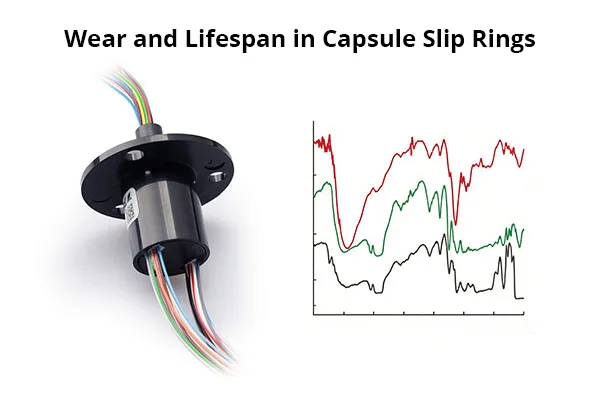
Engineers may not realize how much wear and tear builds up over time because these units are often sealed and sold as maintenance-free. To choose the right product and ensure the system lasts a long time, you need to understand how capsule slip rings work and the factors that affect their lifespan. Most standard commercial capsule slip rings can spin between 10 million and 50 million times. High-performance designs can spin between 100 million and 300 million times.
How Capsule Slip Rings Wear with The Core Mechanisms
The wear in a capsule slip ring is not a one-time event; it occurs over time due to a number of physical and chemical processes working together. You can guess where degradation will start and which design choices will slow it down if you understand each one individually.
Brush to Ring Contact Wear and Material Transfer
The way it works is that, regardless of whether multi-strand or single-strand wires are used, the flexible metal wire brush always remains in contact with the rotating conductive ring.When something rotates, friction removes material in two main ways: adhesive wear, where material moves between mating surfaces through microscopic welding and tearing, and abrasive wear, where harder, oxidized debris particles cut into softer contact surfaces.
The debris is especially important in capsule designs. The sealed housing catches wear particles, which can move onto nearby ring tracks and gaps in the bridge insulation. In high-circuit-count units, the space between rings can be as small as 0.38 mm. It means that debris can build up and cause inter-circuit crosstalk or short circuits long before the brush material is used up. Finding the best balance is a key part of designing capsule slip rings.
Surface Film Formation and Oxidation
Over time, oxide or tarnish films build up on all metal contact surfaces. When sulfur is in the air, silver becomes silver sulfide, which is both conductive and resistive. When you use gold normally, it doesn't make a big oxide layer. As the brush moves normally, it repeatedly breaks up and reforms these films. The films do get thicker, though, when they aren't used for a long time. When you restart, the initial contact resistance goes up until the brush action breaks up the buildup.
Silver graphite brushes need air with about 15% to 85% RH to maintain a lubricating transfer film at the contact point. Outside this range, both wear rate and noise increase. Gold-on-gold contacts eliminate this humidity sensitivity. For this reason, most capsule slip rings for signal circuits use precious metal contacts.
Key Factors That Determine Capsule Slip Ring Lifespan
The rate at which wear builds up is not fixed; it depends on choices made during design and specification. The following factors each have a measurable and controllable effect on how many times a capsule slip ring can reliably deliver.
Contact Material Selection with Gold, Silver, and Composite Brushes
Choosing the right materials for the brush ring interface is the most important design factor in determining how long a capsule slip ring will last.
Contact Material | Current Capacity | Oxidation Resistance | Wear Rate | Best Use |
Gold-on-gold | Low–moderate (≤2 A/circuit)
| Excellent | Very low | Signal, data, sensor
|
Silver alloy | Moderate–high
| Poor | Moderate | Power circuits
|
Silver graphite | High
| Moderate | Moderate | Power, through-hole
|
Palladium alloy (Palliney 7) | Moderate
| Excellent | Very low | Aerospace, military
|
Gold-on-gold contacts have the least friction, make the least amount of debris, and don't rust. They are the default choice for CCTV, Ethernet, USB, and sensor circuits. Silver materials can carry more current, but they tarnish and leave behind more abrasive debris. It makes them better for power circuits that need to be maintained. Palladium alloys like Palladium-7 are used in high-reliability aerospace and defense capsule designs where service life is more important than cost.
Because the ring is machined into the rotor body in capsule form factors, replacing the ring is like replacing the whole unit. Designing for brush sacrifice is a must.
Rotational Speed and Surface Velocity
More RPM means that the brush wears out faster, and the sliding distance per unit of time is greater. Capsule slip rings have small rotor diameters, which is good for them. It is because the linear surface velocity equals the angular velocity multiplied by the radius. Smaller rotors have lower contact surface speed at any given RPM than larger designs, reducing frictional heating and extending contact time.
The highest speed for standard capsule units is 150-300 RPM, while high-performance fiber brush units can handle 2,000-6,000 RPM. Going over the rated RPM ceiling, even for short periods, accelerates wear geometrically and worsens electrical noise. Consistently running below the rated maximum increases service life by the same amount.
Electrical Load and Thermal Stress
When current flows through the brush ring interface, it makes I²R heating at the contact points. Because the thermal mass and size of the enclosure are small, this heat doesn't spread well in small capsule housings. Instead, it stays concentrated at the contact zone. Too much current can make contact materials softer, wear down adhesives faster, and even cause micro-welding between the brush and ring surfaces. When micro-welded contacts turn, they break, leaving surface pits that increase current density in subsequent cycles.
One of the best ways to make capsule slip rings last longer is to run them at 60% to 80% of their rated current. Signal circuits are very sensitive. Even small changes in contact resistance due to wear can mess up Ethernet, USB, or HD-SDI transmission long before the same change would affect a power circuit.
Operating Environment and Its Effect on Wear
The theoretical service life is based on the materials used and the electrical load, but the actual service life depends on the environment in which the unit works. Temperature, humidity, contamination, and duty cycle can all accelerate wear far beyond what lab ratings suggest.
Temperature, Humidity, and Contamination
Capsule slip rings can operate over a temperature range of -30 °C to +80 °C. If you go outside of this range, the bearing lubricant will either thicken or thin out, the plastic housings will lose their shape if they are exposed to heat for a long time, and the insulation resistance between the ring tracks will weaken. IP51 protection works well in clean, controlled indoor areas. Every time the contact surface rotates, particles that settle on it act as a grinding compound, wearing down the rings much faster than just brush friction alone would. Corrosive agents like hydrogen sulfide, salt spray, and solvent vapors work by causing chemical reactions rather than by rubbing against surfaces.
Continuous vs. Intermittent Operation
At 100 RPM, a 50-million-revolution rating runs out in about 347 days. Using it only sometimes gives you more time on the calendar, but it also causes its own problems. Every time you start the engine cold, the interface goes through a short high-friction phase before dynamic sliding takes over. Each time, the motor inrush current makes short thermal spikes at the contact points. Long periods of downtime add another layer: oxide films build up on stationary contacts, and bearing lubricant tends to move away from where it is needed. Running the unit at low speed for short periods during long periods of inactivity keeps the surfaces in good condition and maintains a steady lubricant distribution.
Common Failure Modes and Early Warning Signs
When the brush rotates, the first measurable sign of wear, debris buildup, or oxidation is usually an increase in dynamic resistance. If the motor is making more electrical noise, it could mean the brushes aren't pressing evenly, debris is bridging, or the bearings are wearing out, causing contact bounce. If you see high bit-error rates or occasional data circuit dropouts, it's a sign that the contact interface is deteriorating. The fastest way for a circuit to fail is for conductive debris to connect two ring tracks. When a sealed capsule design fails, it usually happens slowly, and the components may not notice it until the system level shows signs of it.
Design and Maintenance Strategies to Maximize Service Life
Turn down the speed and power settings. Running at 60% to 80% of the rated current and below the maximum RPM reduces thermal and mechanical stress without changing any hardware. Never attach both the rotor shaft and the stator housing to rigid machine structures at the same time. It will throw off the alignment of the bearing assembly, place radial loads on it, and cause the brushes to wear unevenly over time. Use rubber hose pieces, bellows, or spiral couplings that can bend to make up for eccentricity. Make sure the lead wires are routed and secured so they don't put any side loads on the housing or stop it from turning freely.
For applications that run all the time, set inspection intervals every 3 to 6 months; for applications that run only sometimes, every 6 to 12 months. Check rotational torque and vibration, measure and trend contact resistance, and keep track of estimated cumulative revolutions when you can. Instead of fixing things in the field, design the system so that units can be replaced. Capsule slip rings are sealed, precise assemblies that can't be fixed in the field. Planned replacement before failure is possible due to easy-reach mounting options and accurate service-hour records.
Conclusion
The lifespan of a capsule slip ring is determined by the materials used for contact, the amount of current it can handle, the speed at which it rotates, the operating conditions, and the number of times it is used. The sealed, compact shape that makes these parts appealing is also what makes them hard to engineer: limited thermal dissipation, no field access, and tight inter-circuit spacing all make it easier to make mistakes. The most reliable ways to get the service life these parts can provide are to be conservative when derating from rated limits, follow proper installation procedures, and keep an eye on things. Getting slip ring makers involved early in the design process, before you decide on the number of circuits, current ratings, and environmental specs, is still the best way to ensure reliability.
NBG Innovations Group Pte.Ltd.
#13-13A, International Plaza, 10 Anson Road, Singapore (079903)


Navigation
 HomeSustainable
Product