


What Is a Fiber Optic Rotary Joint: Complete Beginner to Expert Guide
BY NBG
 2025-12-22
VIEWS: 3393

What Is a Fiber Optic Rotary Joint (FORJ)?-Complete Beginner-to-Expert Guide
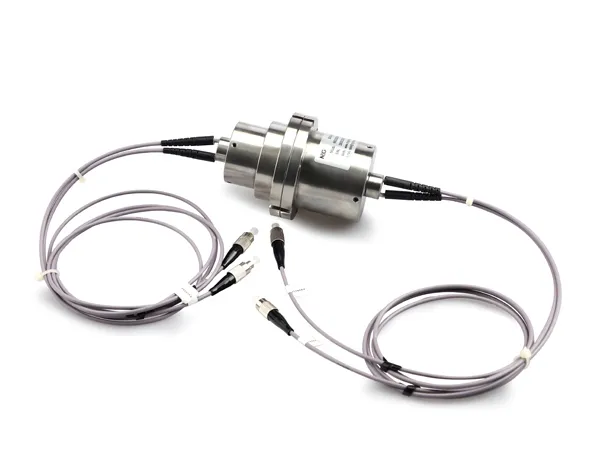
A Fiber Optic Slip Ring (FORJ) is a technology that conveys optical signals between non-rotating and rotating components without gaps or interruptions. It is used in applications that need rapid data transfer, such as robotics, 360° cameras, and medical systems. So, let’s take a quick look at what it does and why it’s useful.
Understanding Fiber Optic Rotary Joints (FORJ): The Basics
Fiber optic rotary joints enable the continuous transmission of optical signals during the rotational movement of components.
What Is a FORJ?
A FORJ (Fiber Optic Rotary Joint) is a product that enables the passage of light signals between fixed and rotating components without interruption. Compared to electrical slip rings, FORJs use optical fibers to pass data, thus offering high bandwidth and low noise, and are not susceptible to electromagnetic interference.
Why Traditional Slip Rings Can't Handle Fiber Optics
The conventional slip rings are based on metal brushes and electrical contact. This causes friction, noise, and loss of signal - this makes them inappropriate for delicate optical signals. Fiber optics demands accurate alignment and transmission by light, which can only be sustained by FORJs during rotation.
How Fiber Optic Rotary Joints Work
The working principle of FORJs is to align the optical pathways so that light passes through a rotating interface with minimal loss.
Core Operating Principles:
● Transmission of Light by a Rotating Interface: FORJs can pass optical signals between fixed and moving components such that data flows are continuous as the components are rotating.
● Optical Alignment Mechanisms: The alignment of optical elements and lenses must be done properly so that the light path remains stable and does not cause loss or distortion of the signal when the object is rotated.
● Single-channel and multi-channel: Single channel FORJs carry a single optical signal, whereas multi channel FORJs carry multiple optical signals simultaneously, enhancing data capacity and system flexibility.
Key Components of a FORJ
● Lenses: Focus and direct light precisely between rotating parts.
● Rotor and Stator Assemblies: Enable smooth rotation without interrupting the optical path.
● Fiber Pigtails or Connectors: Allow easy connection to optical systems.
● Bearings: They maintain consistent rotation and alignment for better signal transmission.
● Enclosure and Sealing: They safeguard internal parts from dust, moisture, and other environmental influences.
Coupling Technologies Explicated
The flow of light across the rotating interface depends on the different coupling methods.
Direct Contact Coupling
The fiber ends are positioned extremely close together. This offers low insertion loss but requires precise alignment and is more susceptible to wear.
Off-Axis Coupling
It uses lenses to redirect light that does not travel through the center, offering greater flexibility but resulting in slightly higher signal loss.
On-Axis Coupling
The light passes along the axis of rotation. This provides a consistent performance and is typical of precision applications.
Pros and Cons
● Direct contact: Has minimal loss, small size. However, it is prone to contamination.
● Off-axis: Better tolerance of misalignment; moderate loss.
● On-axis: Superb stability; it can use more complicated optical pieces.
Types of Fiber Optic Rotary Joints
So, let’s look at how different FORJ types match different system needs.
Single-Channel & Multi-Channel FORJs
● Single-channel FORJs support a single optical path, making them suitable for simple or low-data-rate systems.
● Multi-channel FORJs support multiple fibers, enabling high data rates or backup communication lines.
Single-Mode & Multi-Mode FORJs
● Single-mode FORJs facilitate long-distance ultra-high-bandwidth communication.
● Multi-mode FORJs are easier to align and are cost-effective for shorter-range communications.
Hybrid FORJs
Hybrid units integrate optical channels with electrical slip rings or RF rotary connections. They are optimal where the devices require mixed power, data, and optical transfer within a single rotating interface.
Key Performance Specifications
Parameter | Description | Performance Note |
Insertion Loss | Amount of optical energy lost at the connection. | Lower values preserve signal quality. |
Return Loss | Degree of light reflected back within the fiber. | Higher values reduce reflection and improve overall performance. |
Bandwidth / Data Rate | Maximum data-carrying capacity of the FORJ. | Single-mode FORJs typically support higher rates. |
Rotational Speed | Maximum rotation speed while maintaining stable transmission. | Must match the system’s required rotational dynamics. |
Operating Wavelength | Common wavelengths are 850 nm, 1310 nm, and 1550 nm. | Select according to system specifications. |
Channel Count | Number of independent optical channels.。 | Usually 1–30 or more in multi-channel systems. |
Environmental Ratings | IP rating, temperature range, shock/vibration tolerance, and material durability. | Essential for harsh or industrial environments. |
Key Applications of FORJs
FORJs are widely used across many industries.
Medical Imaging Systems
FORJs let CT and MRI scanners rotate 360° without stopping, keeping optical data fast and stable without signal loss or twisted cables.
Defense and Aerospace
FORJs play a key role in supporting essential defense and aerospace operations:
● Radar systems and spyware cameras: enable 360-degree scanning without data loss
● Unmanned vehicles and turret systems: provide real-time control and monitoring.
Industrial Automation
Robotics and automated systems require FORJs for precise operation:
● Robotic systems: Wireless communication between fixed controllers and moving components.
● Automated inspection systems: high-resolution image and measurement during production.
Wind Energy
FORJs enhance the effectiveness and safety of wind turbines:
● Turbine monitoring and control systems: real-time data reporting of rotating blades.
● SCADA data transfer: ensures reliability in remote monitoring and optimizes performance.
Entertainment and Broadcasting
FORJs complement contemporary entertainment technology:
● 360-degree camera systems: dynamic, high-definition imaging without cables.
● Stage lighting and effects: supports intricate motion and control systems for live events.
Advantages and Limitations
Need to know the strengths and weaknesses of Fiber Optic Rotary Joints (FORJs) in order to integrate them effectively into the system.
Key Advantages
● Very large bandwidth (much higher than electrical), allowing high-speed data transmission without bottlenecks.
● Anti-emission immunity (EMI) that guarantees a stable operation under high-EMI conditions.
● Greater transmission distances without the degradation of the signal.
● Lightweight and compact design makes FORJs ideal for aerospace, robotics, and medical applications.
Problems and Concerns.
● Expensive compared to electrical slip rings, and this can be a problem when planning the budget.
● Precise alignment requirements demand careful fitting and adjustment.
● Sensitive to contamination and environmental factors, requiring appropriate precautions.
● Maintenance considerations, including regular inspections to ensure optimal performance.
Selecting the Right FORJ
Bandwidth and data rate requirements: Ensure that FORJ can support the system's data transmission volume.
● Number of channels required: Decide on the number of optical paths your application requires.
● Rotational speed considerations: Ensure it is compatible with the system's rotational dynamics.
● Environmental factors: Test the temperature, humidity, and pollution levels.
● Budget constraints: Trade performance gains against available funding.
● Single-mode or multi-mode decision factors: Choose based on distance, bandwidth, and cost trade-offs.
● Integration with existing systems: Ensure it is well-matched to the existing infrastructure and equipment.
Conclusion
FORJ opens up entirely new possibilities for wireless data transmission in rotating systems.
They’re fast, reliable, and perfect where traditional slip rings fall short. Understanding FORJs can give your project a real edge. Curious how they might fit into your setup? Dive in and see the difference yourself!
NBG Innovations Group Pte.Ltd.
#13-13A, International Plaza, 10 Anson Road, Singapore (079903)


Navigation
 HomeSustainable
Product