


Wind Turbine Slip Ring Materials: How Brush and Contact Ring Materials Affect Performance
BY NBG
 2026-10-08
VIEWS: 681

Wind Turbine Slip Ring Materials: How Brush and Contact Ring Materials Affect Performance
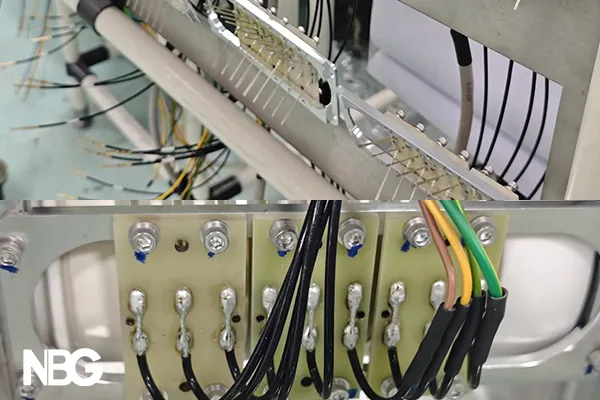
How do you send power and control messages across an interface that is spinning? That's a very simple problem that the slip ring solves in a wind turbine. It is needed to control blade pitch, yaw systems, and rotor excitation in machines with two feeds. That shift happens where the brush meets the ring, which is also where the most wear is likely to occur.
What matters most is how the materials are paired at that interface. How long the turbine runs before it needs to be fixed, how much current it can carry, and how fast it wears out all depend on this.
The Two Sides of the Contact Interface
Every slip ring assembly has two parts that work together. The spinning conductive track on the shaft is called the contact ring, which is sometimes called the slip ring itself. As it spins, current and signals enter and exit it. The fixed half is the brush, a conductive block on a spring held in a brush holder that presses against the ring surface in a controlled, steady way.
Together, these two parts must meet five success criteria that show up all over this article:
Contact (slip) rings, the rotating conductive track:
The amount of power the contact can carry without getting too hot is called its electrical conductivity, or current capacity. Stable contact resistance means the resistance stays the same across speeds, temperatures, and time.
Brushes, the stationary sliding contact:
Wear rate is how quickly brush and ring material wears away at the sliding contact.
Electrical noise is changes in power caused by contacts that aren't stable or consistently working.
Neither half can be designed on its own. To get any of these measures right, think of the brush and ring as a single system.
Brush Materials and How They Affect Performance
Brush material has the biggest impact on electrical conductivity and wear. Your choice depends on the circuit type, current level, and how much noise the application can handle. Many turbine slip rings use two or three different brush grades on their power and signal lines because no single material works well for all three.
Carbon and metal-graphite brushes:
Most slip ring brushes have a carbon or graphite base, with metal powder added to change their electrical and mechanical properties. Copper-graphite, silver-graphite, natural and electrographite graphite, and resin- or pitch-bonded carbon are the major groups.
Graphite is useful because its lamellar crystal structure breaks apart easily when it moves against something, leaving a thin film on the ring surface that keeps it smooth. This reduces friction and slows wear without extra oil.
As temperature rises, carbon's electrical resistance also drops. This property helps keep the contact from overheating. The downside is that carbon-family brushes shed debris. This is manageable: you can control the debris rate by choosing the right grade, and buildup can't become an arc or contamination risk if you inspect and clean it regularly.
Silver-graphite for power circuits:
Most people choose silver-graphite for their main power rings. At the current levels found in pitch-motor and DFIG excitation circuits, silver has the best electrical conductivity of all metals. This keeps resistive losses and contact heating to a minimum.
The graphite part still forms a self-lubricating film, which makes the brush and ring last longer. The result is a brush that can handle a useful current while keeping its wear rate low enough to manage. This is why most -medium- to large-turbine power rings are made with silver-graphite.
Gold and palladium alloys for signal circuits:
Signal and data channels run at milliamps or less, where electrical noise and stable contact resistance matter more than current capacity. The best brushes for this job are made of gold-palladium alloy. They don't rust, keep low contact resistance even after millions of turns, and don't form a resistive film that can mess up a low-level signal.
Because these circuits need to be very precise, the extra cost is worth it. Signals for pitch-angle encoders, vibration-tracking feeds, and communication data links can't handle the noise floor a copper-graphite brush would add.
Metal fiber brushes:
Metal fiber brushes are built very differently. Instead of a solid block, they have thousands of fine metal fibers bundled together. Because each fiber is its own contact point, the total contact force spreads across many places at the same time instead of concentrating in one spot.
The force per contact point is very low, which means that very little debris is created, the rings don't wear out, and the service interval is long. This is a big benefit in nacelle settings where access is difficult or costly.
The main idea is that the right material depends on how the circuit works. For example, the chemistry should depend on whether the ring is carrying power or signals, rather than using the same "best" material for all channels.
Contact Ring Materials and Coatings
As each brush rides against the contact ring, it wears down. This means the ring's material features affect both how long it lasts and how fast the brushes wear it down. Conductivity, hardness, corrosion resistance, and surface finish all affect each other, and each ring material family involves different trade-offs among these features.
Copper and copper alloys/bronze:
Copper and its alloys conduct electricity well and machine easily to very precise surface tolerances. Since pure copper rusts when it's used, it's almost always coated or alloyed. Bronze (copper-tin or copper-beryllium metals) makes things harder and less likely to wear down. It also dissipates frictional heat better than stainless steel, which helps at higher power levels where ring heating becomes a problem.
Precious-metal-plated and solid precious-metal alloy rings:
For signal uses, hard gold plating and silver plating (or full precious-metal alloy rings) protect against the three main ways unplated rings break: surface oxidation, corrosion-driven contact-resistance rise, and electrical noise.
Precious metal surfaces let brushes make less contact, which lowers wear on both sides while keeping resistance stable and low. For signal rings, this is often the only material family that can meet noise standards over a 20-year design life.
Surface finish and hardness matching:
The ring's surface finish is important, no matter what the base is made of. If the ring is too soft, it will groove when brushed, build up debris bridges, and create arcing sites. If the ring is too hard, the brush will wear out faster.
A certain range of surface roughness (Ra), usually between 0.4 and 1.6 µm, is typically accepted, but it can change based on the application and the hardness levels that work with the chosen brush grade. Finish quality also affects how well the tribofilm sticks. A properly finished ring holds the lubricating film in place, while a badly finished one pulls it apart.
Matching Brush and Ring: The Tribological System
Engineers must design the brush and ring as a single system. A tribofilm is a thin, conductive layer that forms when two surfaces touch. It stabilizes resistance, prevents metal-to-metal contact, and slows wear. A good match helps form a stable tribofilm, while a bad match either prevents it from forming or turns it into a protective oxide.
Contact force is the main variable you can change. If you don't use enough, the brush will lose grip when it shakes, causing noise and arcing. Frictional heat and wear will get worse quickly if you use too much. The right window changes based on the brush type, the ring material, and how much the hub shakes.
In turbine settings, the most common ways for things to go wrong are:
● Fretting corrosion: Low-amplitude oscillation breaks up the tribofilm and creates oxide debris that increases contact resistance.
● Grooving and arcing: Ring surface damage and electrical arcing happen when surface hardness or finish doesn't match.
● Oxide-film buildup: Oxidation that builds up on rings that aren't plated or aren't well matched slowly degrades signal or power flow.
Material Selection Guidelines by Circuit Type and Turbine Class
Different turbine platforms have different slip ring needs, so the right material pairing changes too. Start with current levels, rotation speeds, environmental exposure, and maintenance plans.
● For power rings (pitch motor, DFIG rotor stimulation), silver-graphite brushes sit on copper-alloy or bronze rings, and the rings are plated to resist corrosion.
● If you want to keep things simple, you can use gold or palladium-alloy brushes on hard-gold-plated rings for signal or data channels, or metal fiber brushes.
● Offshore or Arctic platforms: rings plated with valuable metals, brush grades that don't rust, and stricter requirements for sealing and surface finish.
● Limited access for maintenance: metal fiber brushes and valuable metal ring surfaces cost more up front but last longer between services.
● In yaw systems, the duty cycle is irregular, and the current is modest. Copper-graphite or silver-graphite brushes on plated bronze rings are common.
Conclusion: Engineering the Right Material Pairing
Reliability comes from matched tribology, the right contact force, a smooth surface, and grades suited to the turbine's duty cycle and climate. The best way to achieve long service life and low total cost of ownership is to work with a supplier that checks brush-ring pairings against your specific platform, rather than providing a catalog default.
NBG Innovations Group Pte.Ltd.
#13-13A, International Plaza, 10 Anson Road, Singapore (079903)


Navigation
 HomeSustainable
Product