


Contactless CT Slip Ring Technology: The Future of Medical Imaging Rotation Systems
BY NBG
 2026-09-10
VIEWS: 1458

Contactless CT Slip Ring Technology: The Future of Medical Imaging Rotation Systems
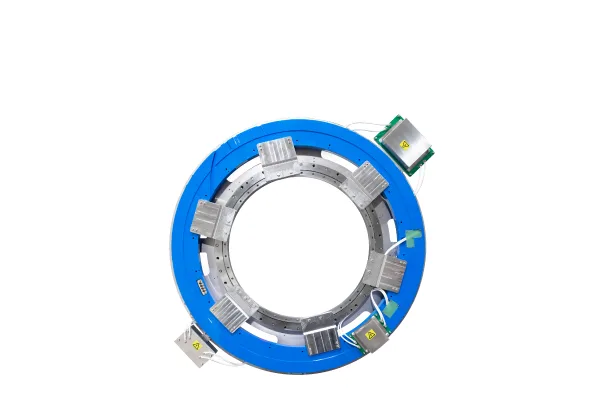
Modern CT scanners struggle to operate because the X-ray tube and detector array must spin very quickly while consuming kilowatts of power and transmitting gigabits of imaging data across a spinning interface. A contactless slip ring, also called a wireless slip ring or medical rotary connection, can fix this.
As detector data rates rise into the gigabit range, non-contact power and data links are replacing brush-based contact systems. These links have better bandwidth, dependability, and longevity.
Limitations of Traditional Contact Slip Rings
In traditional CT slip rings, conductive rings mount on a rotating gantry frame and stationary carbon brushes press them to maintain electrical contact. This worked well enough for decades to send power and low-rate control messages. But as scanners improved, the architecture's flaws became structural issues.
Mechanical wear and maintenance burden
Sliding brushes constantly rub against their contact rings, producing carbon particles that pollute the gantry environment and damage nearby electronics. Brushes need regular replacement, which is a high practical cost in busy clinical settings where scanner downtime directly affects the number of patients seen and the revenue generated. Each maintenance window costs money for parts and labor and reduces revenue.
Data bandwidth ceiling
This is what makes change possible. In the beginning, CT systems only sent data at slow speeds (20 to 800 Mbit/s), which brush contacts could handle. These rates kept rising as helical scanning, multi-slice acquisition, and wide-area detection arrays were added.
Modern CT systems that count photons generate a large volume of data that contact interfaces can't safely handle. A sliding electrical contact has a hard ceiling that engineering refinement can't remove. This means that a non-contact solution for the data path is a necessity, not a nice-to-have.
Electrical noise and reliability
High-current brush-and-ring contacts make electrical noise, such as micro-arcing and short-term changes in contact resistance, that directly affects the detector readout electronics' sensitive analog circuits. In a system where signal integrity directly affects picture quality and dose effectiveness, that noise floor matters.
What Is Contactless Slip Ring Technology?
A contactless slip ring is also known as a wireless slip ring, a non-contact rotary joint, or a medical rotary link, depending on the company that makes it and the use for it. Power and data are sent across the rotating-to-stationary link without any sliding contact. This is done with near-field electromagnetic coupling. People who search for any of those terms will get similar answers.
Two coupling domains
Most of the time, CT contactless rings combine two separate electromagnetic channels into a single rotating joint body. Power is transmitted through an inductive channel, essentially a rotating transformer. High-speed data is sent through a capacitive or optical channel. The joint is formed around a free inner bore large enough to accommodate the patient's opening, which is usually more than 1 meter across.
The sensitive data link needs extensive electromagnetic shielding between the high-power inductive section and the data link, because the power transformer's magnetic field would otherwise interfere with the data signal. One of the main design challenges in these devices is managing that interference.
Contactless Power Transmission
Inductive power transfer (IPT) across the CT rotary interface operates like a transformer: an air gap separates the primary and secondary windings, which rotate. The primary winding stays still while the secondary winding rotates. In a normal transformer, both windings stay in place. But in this case, one side keeps rotating. This is because magnetic coupling doesn't need mechanical contact.
Handling CT-scale power
On the spinning side, CT gantries require significant power. Depending on the system class and X-ray tube specifications, vendor patents and literature cite values from about 10 kW to over 100 kW. To power the tube, the rotating side must generate a voltage above 100 kV.
Transformer cores use iron or ferrite to focus and direct magnetic flux across the air gap. Free-bore diameters larger than one meter are common. This means you have to design a transformer geometry that works consistently at that size while maintaining high coupling efficiency across manufacturing tolerances.
System-level benefits
The large power inverter and high-voltage generation circuitry can be moved to the stationary frame when inductive transfer handles the power path. This is a notable architectural benefit that has been written about.
This reduces mass, volume, and thermal load on the rotating side, all of which matter at the high rotational speeds required by modern scanners. Safety engineering is also easier when there are fewer fast-spinning high-voltage parts. Power numbers vary by product, so always check the main manufacturer's datasheets for any system.
Wireless Data Transmission
Two non-contact data transmission approaches are used across CT rotary interfaces, each with distinct characteristics and trade-offs.
Capacitive coupling
Capacitive data links use coupler plates that are precisely machined to face each other across a small, rotatable gap. High-frequency signals can pass through this gap via capacitance. On both sides, the encoder and decoder electronics adapt standard network protocols to work over the link.
Real-time capacitive transfer rates of up to 5 Gbit/s per channel have been recorded for commercial CT products. Check these numbers against the latest product datasheets, as this field is always changing. The method is mechanically robust and less likely to be disrupted than optical systems.
Optical transmission
Optical links use LEDs or lasers to turn data from detectors into light, send it across the spinning gap with lens assemblies, and then change it back on the side that isn't moving. With speeds above 10 Gbit/s, the bandwidth potential is high. However, optical devices have problems that make them less useful in real life.
It's easy for particles to hurt them, which was a problem in places where carbon brush dust was common. To align and keep the optical path, they need a more complicated system. In some cases, this has made wireless links more competitive, hurting optical's market share.
Emerging near-field / high-rate modules
The edge is moving quickly. Contactless data modules with speeds of up to 25 Gbit/s per channel have been released recently for photon-counting CT uses. The areas being talked about in these claims are still being worked on, and exact numbers should be checked against records kept by the manufacturer. But they do show where the business world thinks demand will land.
Advantages of Contactless Slip Rings
Removing the sliding contact device directly yields benefits.
No mechanical contact wear
Without brushes, there is no friction-driven wear, no carbon particle formation, and no gradual loss of touch quality over the ring's life. The signal's stability remains the same as when it was first put into service.
Longer lifetime
The rotary joint lasts a lot longer when the main wear-out part is taken out. Check the rotation counts or year numbers the vendor gives you. Still, the structural argument is easy to understand: a non-contact coupling has no wear part that needs replacing.
Lower maintenance
Eliminating the need to replace brushes reduces planned downtime and the labor costs that come with it. That smaller planned-maintenance window is very helpful for imaging teams with heavy workloads running two or three shifts.
Higher reliability
Without sliding contacts, there are no intermittent contact faults and no noise in the data path from the contacts. This strengthens the signal for the detector electronics and lets them run at the faster, more stable speeds modern acquisition methods need.
Some trade-offs engineers must consider include tighter mechanical alignment tolerances across the rotating gap, careful EMI shielding between the power and data channels, and the fact that these systems are harder to build and integrate at the start than brush systems. These costs are real, not just notes.
Future Applications
The future applications of contactless CT slip rings are as follows:
Next-generation and photon-counting CT
Photon-counting CT (PCCT) is the most difficult case. Direct-conversion detectors with a small pixel pitch and the ability to resolve energy levels produce large amounts of data per rotation that contact interfaces can't handle.
FDA-approved PCCT systems are already in clinical use. Broader spectral imaging tools will follow. For this generation of scanners, contactless data links are essentially a must for PCCT deployment; the technology is not optional.
Advanced imaging systems beyond CT
When gigabit data needs to pass through a rotating boundary, the same non-contact rotary architecture works. This includes security CT, industrial inspection systems, high-speed non-destructive testing, and other rotating medical imaging platforms. The core engineering approach works well in many areas.
Design direction
New ideas in active engineering include higher per-channel data rates to accommodate larger detector arrays, tighter physical integration of power and data channels within a single joint body, and improved shielding architectures that handle EMI interactions between the two channels at higher power and data levels simultaneously.
Conclusion
Power transfer and low-rate signals can still use contact slip rings, but the data path and, increasingly, the power path are moving toward contactless architectures. As technology improves, medical rotary connectors and wireless slip rings enable the gantry to rotate faster, require less maintenance, produce less electrical noise, and handle more data.
The performance requirements will only get tougher as photon-counting CT moves from early clinical use to broader adoption. If you are evaluating medical rotary connector options for a CT platform or high-speed imaging application, please contact the team. They can help you choose based on your system's power and data needs.
NBG Innovations Group Pte.Ltd.
#13-13A, International Plaza, 10 Anson Road, Singapore (079903)


Navigation
 HomeSustainable
Product