


Designing Slip Rings for High Speed Applications
BY NBG
 2025-12-12
VIEWS: 1809

Designing Slip Rings for High-Speed Applications
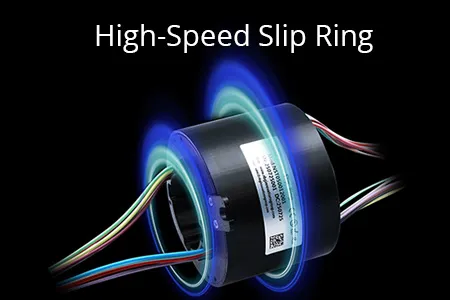
Slip rings work to make rotations smooth. They facilitate the transfer of power and signals between rotating and fixed parts of a system. In high-speed systems, the design quality is the main determinant of success. In these situations, every detail is important, from balance to heat control.
Understanding High-Speed Slip Ring Fundamentals
What Constitutes "High-Speed"?
A slip ring is considered high-speed once it crosses the threshold of 5,000 RPM. In certain aerospace and test systems, it is even common to encounter slip rings with rotation speeds of 100,000 RPM.
While rotations depend on speed, the linear velocity at the contact points also plays a vital role. Increased contact speeds will lead to accelerated wear, noise, and heat, all of which require management.
Basic Operating Principles
Slip rings function by transferring current and data through rotation. In this way, they serve to integrate the static and spinning parts of a system. Power rings are designed to channel large currents.
Signal rings relay both the data and the voltage. Each is designed with certain goals in mind, be it stability, durability, or clarity.
Critical Performance Parameters
Here are a few performance parameters:
●Contact Resistance Stability
Ensuring constant resistance guarantees stable power and data flows. Even minor changes in resistance values can cause a signal drop and a rise in temperature.
●Electrical Noise Levels
Noise increases proportionally to speed. Using high-quality contact materials and brush designs, you can minimize noise.
●Thermal Management
Heat is a result of high-speed motion. Hence, effective cooling and low-friction designs are necessary to increase reliability.
●Mechanical Wear
Contact wear reduces service life. Hence, optimal pressure and surface smoothness are important to slow wearing.
Key Design Challenges in High-Speed Applications
When designing the structure for high-speed applications, you need to consider the following challenges.
Mechanical Challenges
Centrifugal force increases rapidly at high RPMs. This can cause brushed systems to lift or deform. Precision balance is critical to avoid vibration. Bearings are helpful in controlling axial and radial loads. If left, extreme axial load can cause material fatigue.
Electrical Challenges
Stable contact resistance is difficult to achieve. With high current, contact points rapidly heat, causing potential signal noise and EMI issues. To decrease these issues, smart shielding and layout designs are helpful.
Thermal Challenges
Heat is generated with each rotation. Excess heat causes loss of alignment and expansion. For increased thermal balance, better materials and cooling can be used. Thermal balance ensures longer and safer operations.
Material Selection for High-Speed Performance
High-speed performance depends on the right material selection for contact rings, brushes, and even housing structure. Let’s look at each in detail:
Contact Ring Materials
Precious metal alloys like gold and silver are used for the most advanced slip rings. These alloys are non-corrosive and ensure uninterrupted connectivity.
Copper alloys are used for less advanced slip rings that allow the entry of high currents.
Copper alloys are cheaper but need additional coatings, which is not cost-efficient. Surface coatings and treatments are aimed at lower friction and thereby wear from repeated use.
Brush Materials
Metal-graphite brushes combine sufficient strength and conductivity for most applications. Precious metal brushes allow a clean signal path.
Fiber brushes are used because they last longer, are less noisy, absorb more vibrations, and reduce the energy impact.
They generally improve modern slip rings. Compatibility of the materials used for the rings and the brushes is one of the most effective ways to avoid damage.
Housing and Structural Materials
The housing must be made with a material that is lightweight but rigid. The best materials for this purpose are aluminum and composites.
Being good thermal conductors, they allow the heat to spread swiftly. Furthermore, their ability to resist corrosion also allows them to perform in harsh conditions.
Critical Design Considerations
When designing, you can consider these to optimize operations.
Brush Pressure Optimization
The brush pressure needs to be optimized. High pressure can cause excessive wear, and low pressure can break contact. Newer slip rings include dynamic pressure systems. At high RPMs, the springs are stable enough to control them.
Contact Track Design
Performance is affected by the design of the width and the grooves of the contact track. Smooth and polished contact tracks reduce friction and the noise produced. Multi-track layouts separate the power and data to reduce interference.
Cooling and Thermal Management
Thermal expansion and loss of contact are caused by poor heat management. Hence, cooling systems should utilize the design of vents and the surrounding air for passive cooling. Active cooling systems use fans or liquid and heat pipe systems.
Balance and Vibration Control
When speed is high, you need to balance better. The designers should always aim for the strict G ratings. Using vibration isolation pads and tuned mounts helps to reduce stress levels. Preventing resonance also provides stable and long-term motion.
Design Challenges vs Engineering Solutions
You can come across challenges when designing suitable slip rings for high-speed applications. However, many challenges can now be resolved with advanced engineering solutions.
Design Challenge | Effect | Key Solution |
Centrifugal force | Brush lift and wear | Precision balance, fiber brushes |
Vibration | Signal loss, heat | G-grade balancing, damping mounts |
High friction | Heat build-up | Smooth coating, low-contact pressure |
Thermal stress | Expansion, cracks | Air cooling, heat pipes |
Electrical noise | Signal drop | Shielding, clean grounding |
Contact wear | Short lifespan | Surface plating, spring tuning |
Advanced Technologies and Innovations
With the advancement in technology, there are new innovations being made. Let's dive deeper into a few of them.
Fiber Brush Technology
Fiber brushes have transformed the industry. They are flexible, quiet, and evenly worn, preventing them from accumulating heat and friction. Each fiber brush emits a small current to maintain advanced speeds and extend operational lifetime.
Liquid Metal Contact Systems
The mercury-free design uses gallium alloys. These metals conduct electricity without solid friction and withstand very high speeds safely. They are used in aerospace standards and precision test rigs.
When it is crucial to avoid contact, wearables do a wonderful job. Inductive coupling transfers energy magnetically, and in capacitive systems, data is passed through electric fields. These systems don’t require much maintenance as they have no friction.
Testing and Validation
A design is only acceptable when it is thoroughly tested and validated. Here is how the design must meet the standards.
Accelerated Life Testing
High-speed slip rings undergo careful testing. They need to pass thousands of cycle tests under heat and load. This ensures a good assessment of noise, wear, and performance drift.
High-Speed Test Rigs
Engineers use custom test benches to simulate extreme motion. They assess balance, friction, and signal loss. Data certifies that every design achieves the performance set for the rated RPM.
Performance Metrics
Key elements include:
● Contact resistance over a specific time period
● Electrical noise in microvolts
● Temperature elevation per minute
● Brush wear rate per 1000 hours
Quality Assurance Standards
Global industries require precision and consistency. Hence, quality is grounded in ISO 9001 and aerospace standards. Every piece is inspected before it is delivered to clients.
Conclusion
High-speed slip rings require you to give attention to design. Each factor, from the material to the cooling method, is vital. Stable contact, clean signals, and low wear are the hallmarks of success.
With advanced materials and brush technology, speed no longer restricts performance. Such innovations are designed to achieve faster, cooler, and smoother rotations.
NBG Innovations Group Pte.Ltd.
#13-13A, International Plaza, 10 Anson Road, Singapore (079903)


Navigation
 HomeSustainable
Product