


Use of Slip Rings in AC Generators Complete Guide
BY NBG
 2025-12-11
VIEWS: 9559

Use of Slip Rings in AC Generators: Complete Guide
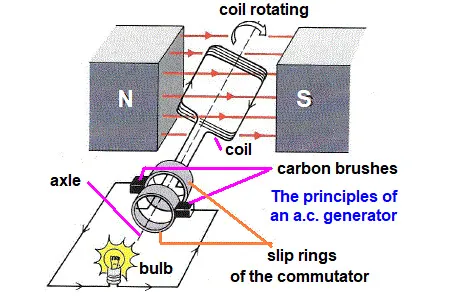
The AC generators could not have been complete without the slip rings that facilitate the smooth flow of electricity between rotating and stationary components. This guide explains the functionality, structure, benefits, and maintenance of slip rings to help you understand why they are vital for efficient power generation.
Basics of AC Generators
One must learn the working principle of AC generators before getting to know the particulars of slip rings.
Principle of Electromagnetic Induction
● Faraday’s law: According to Faraday’s law of electromagnetic induction, an electromotive force (emf) is created across a rotating coil in a magnetic field.
● Induced emf in a coil as it rotates: Since the angular position of the coil varies as the coil continues to rotate, the magnitude and the direction of the induced emf vary, producing alternating voltage.
● Alternating (sinusoidal) nature: The current in AC generators is sinusoidal because the coil reverses its orientation, causing the induced current polarity to reverse each half rotation.
Components of a Simple AC Generator
● Rotor and stator: The rotor has the field winding generating the magnetic field, while the stator holds the stationary armature windings where voltage is induced.
● Slip rings and brushes: They connect the rotating coil to the external circuit, ensuring continuous current transfer.
● Mechanical drive: Provides rotational energy to the rotor via a turbine or motor.
● External load: The generated electrical energy is delivered to the external circuit or load.
Role of Slip Rings vs. Commutators
Both slip rings and commutators transfer current between moving and stationary parts, but operate in different current systems.
Distinction between slip rings (for AC) and commutators/split rings (for DC)
The AC machines have slip rings, whereas the DC machines have commutators or split rings. Slip rings enable an unbroken alternating connection, unlike commutators, which switch connections to generate a direct current.
Why do AC generators use slip rings?
Slip rings are used in AC generators since they have a constant electrical conductor that maintains the alternating current of the resulting output.
What would happen if a commutator replaced slip rings?
If a commutator replaced slip rings, the generator would no longer produce alternating current; the output would become direct current or highly unstable.
Function and Operation of Slip Rings in AC Generators
Slip rings are used to allow the flow of current between the rotating and stationary parts of the generator.
Electrical Connection between the Rotating and Stationary
● Electrical connection between rotating and stationary parts: The current induced in the rotating coil is passed through the slip rings, then the brushes, and on to the external circuit.
● Operation of brushes: The brushes slide on the rings, even at high rotor speeds, to maintain constant electrical contact.
● Multi-phase generators: Slip rings are used on every phase, and equal amounts of power are produced, and the phases are independent of each other.
Maintaining the Alternating Nature of the Output
● Slip rings don’t rectify or invert: Slip rings allow AC to pass freely without altering polarity.
● Natural reversal: The current polarity is reversed naturally since the rotating coil passes through the magnetic field and generates a sinusoidal AC waveform.
Ensuring Uninterrupted Rotation
● Avoidance of wire tangling: Slip rings prevent wires from wrapping around the rotating shaft, allowing unrestricted rotor rotation.
● Mechanical freedom: They provide full mechanical freedom to the rotor, allowing continuous power generation.
Excitation and Field Supply
● Field supply in synchronous machines: The rotor’s field winding may require a DC supply, which slip rings feed to sustain the magnetic field.
● Continuous excitation: Slip rings allow feeding of excitation current into the rotor without stopping the generator operation.
Design Considerations for Slip Rings in AC Generators
A slip ring that is well designed will provide a good electrical contact and long life.
Materials and Construction
● Conductive materials: Copper or brass rings are common for their low resistance.
● Insulation: The rings are insulated around the shaft to prevent short circuits and ensure safe operation.
● Surface quality: The surface of the rings is smoothed and produced with close tolerances in order to reduce friction, reduce noise, and increase their life span.
Brush & Contact Mechanism
● Material: The brushes are usually composed of carbon or graphite, which is a conducting material and a self-lubricant.
● Pressure and friction: Good conductivity is ensured with low friction by having proper spring pressure with the rings and brushes in good contact.
● Spark control: Contact surfaces are smooth, thus limiting the amount of sparking and wear, which guarantees the steady transfer of electricity when it is operating at a high speed.
Number of Rings/Phases
● Single-phase vs three-phase: A single-phase generator employs a slip ring on each of the two ends of the winding, and a three-phase generator has three rings, one on each.
● Arrangement of multiple rings on a shaft: Several rings are placed concentrically on the same shaft, with insulating layers between them to ensure no short circuiting and allow the rings and their rotation to achieve ideal balance.
Thermal, Mechanical, and Electrical Stress
● Heat generation: Contact resistance generates some heat due to friction between the rings and brushes, which should be managed by proper cooling or material selection.
● Mechanical balance: Mechanical tolerances are very important since any form of imbalance or misalignment will lead to vibration and component failure.
● Electrical interference: Should there be contamination or wear of the contact surfaces, electrical noise, arcing, and emission of electromagnetic interference could take place.
Maintenance and Reliability
● Regular inspection: Slip rings and brushes automatically wear with time due to friction, and thus, they require inspection and replacement.
● Cleaning and lubrication: Lubrication and cleaning assist in reducing wear and also in inhibiting contamination that could raise electrical resistance.
● Redundancy: Most systems incorporate backup brush sets or enclosed slip ring assemblies to keep running even if one contact fails.
Advantages and Limitations of Using Slip Rings
Slip rings offer great advantages to the AC generators, but also pose certain challenges.
Advantages
● Continuous AC transfer without interruption: enables the constant flow of energy between rotating and fixed elements.
● Simple electromechanical method: provides a highly effective and proven method of current transmission.
● Flexibility in phase connections: can be single-phase or three-phase.
● Feeding of rotor excitation: allows direct feeding of DC excitation current to the rotor in synchronous generators.
Limitations/Challenges
● Frictional wear and maintenance: wear and tear of brushes and rings: Brushes and rings wear out with time, and should be serviced periodically.
● Contact resistance losses and heating: the slight resistance between the contact points heats and results in minor losses of energy.
● Sparking and electromagnetic interference: ineffective contact or contamination may result in electrical arcing and noise.
● At very high rotational speeds (high-RPM machines), it is hard to maintain stable contact.
● Limitations in high-voltage, high-current, or extreme environmental conditions: Performance and insulation may be impacted by dust, humidity, or corrosion.
Alternatives & Mitigations
● Brushless excitation: a brushless excitation system is employed to avoid the use of slip rings and to minimize maintenance required.
● Rotary transformers and wireless coupling: Power can be conveyed without direct contact by rotary transformers and wireless coupling methods, which increase durability.
● Advanced materials: High-performance materials such as brushes and rings are employed to make operations last longer and work efficiently.
● Sealed assemblies: Sealed or enclosed slip ring assemblies have the advantage of being resistant to dust, moisture, and corrosion.
Troubleshooting, Diagnostics & Best Practices
Correct monitoring and maintenance aid in prolonging the service of slip rings and help sustain the operation of generators.
Monitoring Contact Quality
● Measurement: The poor electrical connection can be detected by measuring the contact resistance and voltage drop across the brushes at an early stage.
● Thermal check: Thermal imaging can be helpful to identify hot spots, which can be signs of excessive friction or electric losses.
Detecting Wear/Damage
● Visual inspection: Frequent physical examination assists in detecting evidence of wear, scratches, or discolouration on the ring surface.
● Checking for grooves, pitting, oxidation: The Presence of pitting or oxidation is a sign of poor contact or environmental pollution that must be dealt with.
Mitigating Sparking & Noise
● Ensuring good brush pressure and surface cleanliness: these are ways of reducing sparking and electrical noise.
● Use of shielding, grounding, and snubber circuits: Electromagnetic interference may be minimized by installing grounding systems, shielding, or snubber circuits to enhance stability.
Maintenance Schedule & Replacement Guidelines
● Maintenance intervals: Set based on usage hours and environment.
● Spare inventory: Keep replacement brushes and rings ready for service.
Conclusion
Slip rings play a very crucial role in the constant and smooth functioning of the AC generators. Knowing how they work, how they are built, and how they are maintained will guarantee improved performance, long service life, and dependable production of electricity.
NBG Innovations Group Pte.Ltd.
#13-13A, International Plaza, 10 Anson Road, Singapore (079903)


Navigation
 HomeSustainable
Product