


Medical Slip Ring Applications Beyond CT Scanners
BY NBG
 2026-09-21
VIEWS: 750

Medical Slip Ring Applications Beyond CT Scanners
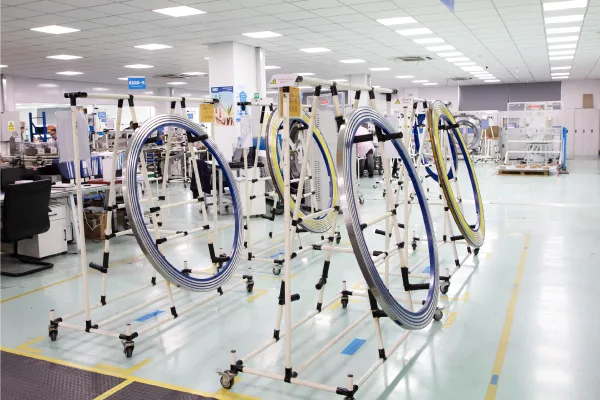
This is what most people think of when they hear the word "medical slip rings." It's hard to send power, high-speed data, and control signals across an interface that keeps turning without the cable winding up. This is a problem that a lot of modern medical equipment has.
As imaging and surgeries become more robotic, motorized, and focused, medical slip rings have grown in importance. This article covers the main places this rotary transmission idea is used and the important work it does in the background.
The CT Baseline — A Quick Reference Point
In CT, the X-ray tube and detector array keep moving around the patient gantry. This requires high-voltage power and the ability to send large projection datasets at the same time, in real time. That mix made CT the standard slip ring use and led to decades of improvements in contact materials, signal blocking, and the ability to handle different rotational speeds.
Many of the uses listed below are based on CT-derived slip ring engineering that has been scaled down, the power level lowered, or extra restrictions added, like needing to be magnetically compatible, sterile, or fit into small spaces. CT is the standard against which everything else is judged.
C-Arm and Mobile Fluoroscopy Systems
Surgical C-arms and mobile fluoroscopy units have imaging arms that can move around the patient during treatment. Unlike a fixed CT gantry, this one moves during surgery, and the doctor usually has to move it more than once while working. The arm has a built-in slip ring that lets it rotate continuously beyond 360 degrees. The slip ring carries power to the detector, control signals, and connections for the X-ray tube. The contacts are hidden so that workers never come into contact with live wiring. Patent material, such as US 6,113,264, supports the continuous-rotation structure in C-arm designs.
Why does continuous rotation matter intraoperatively?
In orthopedic surgery, such as hip or spine repair, the surgeon must keep moving the tool to ensure the implant is in the right place from different angles, without stopping to unwind the cables. In vascular and endovascular work, real-time fluoroscopic images help the catheter move through bodies with many branches. Without rotation, the process takes longer. There is no hard stop on the rotary connector, so you can move the arm in any direction.
Design implications
Mobile C-arms have strict size and weight limits, so the slip ring must be small and light without compromising contact with the arm. Low electrical noise is also critical because interference in the power and signal path can degrade fluoroscopy image quality. The unit also moves a lot during different procedures, so it needs mechanical strength provided by clinical-grade contact materials and sealed housings.
MRI-Compatible and Non-Magnetic Rotary Systems
A common misunderstanding is that MRI machines use spinning slip-ring gantries the same way CT machines do. The MRI magnet stays in one place. In an MRI machine, slip rings are most useful inside MRI-guided interventional robots, patient positioning systems, and other machines that need to work inside or near the bore.
The non-magnetic requirement
Ferromagnetic materials are dangerous near a high-field magnet and distort the field in ways that corrupt image quality. Medical rotary connectors for MRI rooms are made from non-magnetic stainless steel and titanium alloys to prevent field distortion and image artifacts. RF and EMI management are both very important. Any noise that the rotary connector adds to the imaging chain reduces diagnostic value. These material and shielding requirements come from the vendor and should be checked against component-level datasheets for each application.
Where do they appear?
The main use case, and the one that is growing the fastest, is MRI-guided interventional robots. Biopsy guide systems, robots that insert needles, and platforms that keep a patient stable while they move inside a bore all need rotary joints that can transmit motor power and position information without changing the magnetic field. The slip ring isn't just an extra part of these systems; it is also what makes MRI-guided robotic action possible.
Surgical and Interventional Robots
After CT scanners, robotic surgical systems may be the fastest-growing market for medical rotary connectors. In a robotic arm, slip rings live inside the joints and instrument driver assemblies. They transmit motor power, control signals, encoder and position inputs, and, in some designs, video. This lets each joint move freely without being limited by fixed wiring.
The single-point-of-failure reality
Power, data, and control signals often come together through a single rotary link per joint, so the signals must be correct and the joints must be reliable. When contacts in a surgical robot joint break or a signal drops, it's not just a maintenance issue; it's also a patient safety issue. This is what sets custom medical rotary connectors apart from standard industrial parts. It also sets a high standard for the quality of the contact materials, backup plans, and proven service life.
Miniaturization and through-bore designs
To fit within the arm's mechanical envelope without adding bulk, precision robotic joints need small outer diameters and through-hole formats. For fast image and data transmission, hybrid designs mix electrical channels with fiber-optic passages. This enables the multi-gigabit throughput current robotic platforms need. Data-rate performance depends on the vendor and should be checked against published specs instead of broad numbers.
Endoscopy and motorized camera heads
Small slip rings let the optic modules in motorized endoscopes rotate, sending power and video across the camera head as it rotates. As endoscopic platforms become more flexible and use higher-resolution sensors, the rotary connector in the camera unit starts to limit image quality and the range of rotation.
Diagnostic and Specialty Imaging Equipment
Rotating-gantry imaging is used in many diagnostic tools besides full-body CT scans. These tools use small slip rings to do the same basic job.
Dental and ENT cone-beam CT (CBCT)
A cone-beam CT system has a head that can spin and an X-ray source and a flat-panel detector that move around it. In a single rotation, the head can usually take 150 to 200 or more projection images. A slip ring moves power and data from the detector around that circle. It's not as big or powerful as a full-body CT gantry, but it does the same job. One of the best-studied non-whole-body uses of CBCT is in dentistry. Strong evidence comes from both academic imaging studies and large-scale clinical use.
Cone-beam / dedicated breast imaging
Patents for cone-beam breast CT designs show that the gantry and the host communicate through a slip ring. As a result, the rotating motion that enables isotropic three-dimensional reconstruction can be used instead of the compression needed for regular mammography.
Rotating ultrasound and scanning assemblies, lab analyzers, and rehabilitation robots
Ultrasound transducer units that rotate have tiny slip rings that let images be taken inside the heart and blood vessels. To make a cross-sectional picture, the transducer has to spin. Automated lab analyzers with spinning sensor platforms and diagnostic instruments that look like centrifuges also use the same rotary connectors to keep power flowing while the instruments spin. The last type in this group is rehabilitation robots with motorized joint systems. When designing medical devices and electrical systems together, they use the same slip-ring rules.
What Sets a Medical Slip Ring Apart — Design and Compliance
A medical-grade rotary connector differs from a general-industry one in several ways, based on engineering standards.
Signal integrity and low noise
Electrical noise affects both medical imaging and robot control. Gold-on-gold contact pairs, careful channel layout, and shielding minimize crosstalk and noise in the signal path.
Reliability and service life
In clinical settings, unplanned downtime is not allowed. Standard practices include placing precious metals close together and maintaining equipment for long term reliability. Procurement and biomedical engineering teams use validated service-life data to track equipment usage.
Safety and standards
IEC 60601-1 sets the rules for electrical safety for medical equipment. It includes limits on leakage current that vary by the type of part used (Type B, BF, or CF). Check specific clause-level rules and numerical limits against the most recent version of the standard rather than relying on references from other sources. Beyond electrical safety, a compliant medical rotary connection's design depends on housing biocompatibility, ease of cleaning, and the size and weight limits of mobile equipment.
Conclusion
The medical slip ring has come a long way since its beginnings in CT scans. In a clinical setting, safely sending power and data across an interface that is always turning is a problem that comes up in everything from intraoperative fluoroscopy to MRI-guided robotics, surgical arm joints, cone-beam dental imaging, and rotating diagnostic assemblies.
What changes is the set of restrictions, such as nonmagnetic materials, extreme miniaturization, high-data-rate hybrid channels, or IEC 60601-1 compliance. A medical rotary connector made for that purpose differs from an industrial part used for something else. Visit our medical slip ring features page to learn more about how NBG handles this wide range of medical uses.
NBG Innovations Group Pte.Ltd.
#13-13A, International Plaza, 10 Anson Road, Singapore (079903)


Navigation
 HomeSustainable
Product