


Slip Rings in Theme Park Rides Safety & Reliability at Scale
BY NBG
 2025-12-22
VIEWS: 1061

Slip Rings in Theme Park Rides: Safety & Reliability at Scale
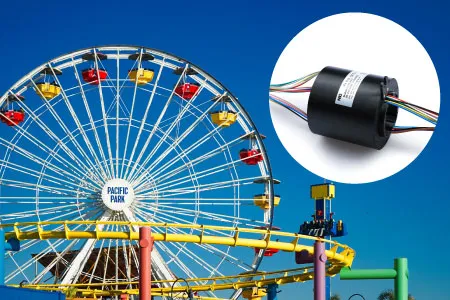
In modern amusement parks and theme parks, rides such as Ferris wheels, carousels, and motion simulators depend on electromechanical slip rings (rotary electrical connectors) to deliver power and signals to their moving parts. Slip rings are used to provide a continuous electrical connection of 360 degrees between the stationary base and the rotating structure, and therefore lights, motors, audio, and sensors can remain powered without a tangle of wires. This smooth transfer of power is essential in the safety and reliability of the theme park ride; quality slip rings maintain continuous power flow to the motors, brake circuit, encoder, and lighting effects as they spin.
Working Principle of Slip Rings in Theme Park Rides
Slip rings follow a remarkably elegant yet practical principle that addresses one of the most fundamental engineering problems: the need to communicate electrical current between a stationary part to one in continuous rotation. It is made up of conductive rings attached to the rotating section of the ride, and the carbon or precious metal brushes are attached to the rings by spring pressure. With the ride spinning, the brushes are always in contact with the conductive rings, and this creates a continuous electrical circuit that permits the flow of power and signals to take place without any gap between the stationary infrastructure and the moving components of the attraction.
A mechanism like this is contact-based, and therefore, regardless of how many times a carousel spins around or how a Ferris wheel gondola locates itself, the electrical connection remains consistent and uninterrupted. Contemporary slip rings made use of new technology like gold-gold contacts, silver-graphite composites, and fiber brushes to minimize electrical noise, wear, and lengthen life span. These brushes are moving over rigidly machined conductive surfaces, which help the transmission of not just the power to the motors and lighting systems but also of the data signals to the sensors, audio systems, video displays, and the complex control mechanisms.
Critical Role of Slip Rings in Theme Park Rides
The theme park rides depend on slip rings, which provide the transition between the static infrastructure and the dynamic movement. Their main functions are to enable 360 rotation without interfering with the electrical integrity, powering important parts of the machine, such as motors, lights, audio systems, and safety sensors. They are used in roller coasters to provide uniform transmission of signals in order to monitor the tracks and in go-round to synchronize the movements of the horse with the thematic music.
In addition to the essential functionality, slip rings enhance the level of immersion. They facilitate interactive elements, e.g., augmented reality in dark rides or LED panels in spinning teacups, which turn otherwise simple attractions into spectacular elements. This translates to increased visitor interaction and income for the operators. More importantly, they enable safety measures by providing real-time information to the control systems so that emergency stops can be made in case of any anomaly. Slip rings are used in high-traffic parks where the rides are running most of the day to eliminate operational failures that would result in expensive downtime. Their incorporation with encoders gives positional precision, which is needed in rides such as the Orbiter or Scrambler, where the extra movement increases the thrill. All in all, slip rings make rides not only functional but reliably enchanting to the expectations of the world's theme parks.
Selection of Slip Rings in Theme Park Rides
Choosing the right slip ring for theme park rides involves balancing technical specs with environmental demands. The most important characteristics are the number of circuits (channels) of power and signals, the maximum voltage of up to 1000 V, and the current limitations to 300A of high-load components such as motors. Diameter is important--the large Ferris wheels use through-bore designs that are more than 70 inches, and the small capsule designs are used in the kiddie rides.
It is essential to be environmentally resilient: instead of dust-resistant, humidity-resistant, and temperature extremes, use IP-rated units and use them in open environments. Such certifications are for design safety (ASTM F2291) and performance (ISO 13849). Take into account rotating speed (up to 300 RPM), low noise, and multiplexing of simultaneous signals without interference. The brush choices, including carbon to create minimal debris, increase lifespan.
Selection Factor | Description | Example Application |
Circuits/Channels | Number of pathways for power/signals | Multi-channel for carousel lights and audio |
Voltage/Current Rating | Handles up to 1000V/300A | High-power motors in roller coasters |
Diameter/Speed | >70 inches, up to 300 RPM | Large Ferris wheels |
Environmental Protection | IP-rated for weather/dust | Outdoor theme park rides |
Certifications | ASTM F2291, ISO 13849 | Safety-compliant installations |
Slip Rings in Theme Park Rides: Safety Scale
At theme parks, for instance, ride safety depends on such details as slip rings that have to be engineered to the highest standards. Amusement slip rings are certified for safety; for example, most are certified to a standard (ASTM F2291, ISO 13849, etc.) and have stringent insulation requirements (usually >1000 MO) to avoid the creation of shorts at high voltage. Such slip rings can be protected by current or voltage protection circuits, which disconnect the slip ring before faults can propagate and cause a catastrophic event such as an unexpected stall or fire. Slip rings also commonly contain encoders and position sensors in a single unit, allowing ride controllers to have instant feedback of rotation.
Reliability of Slip Rings in Theme Park Rides
Reliability defines slip rings' success in theme parks, where downtime equates to lost revenue. Built with durable materials like carbon brushes and aluminum housings, they resist wear, corrosion, and heat, offering maintenance-free operation for extended periods. Fiber brush technology minimizes debris, preventing jams in high-vibration environments.
Reliability Feature | Benefit | Impact on Rides |
Carbon Brushes | Low wear/debris | Reduces maintenance in carousels |
Aluminum Housing | Heat dissipation | Prevents overheating in outdoor Ferris wheels |
Multiplexing | Signal integrity | Ensures clear audio in simulators |
Encoder Integration | Position accuracy | Enhances control in scramblers |
IP-Rating | Environmental resistance | Boosts longevity in rainy parks |
Benefits of Slip Rings in Theme Park Rides
The integration of properly specified slip rings delivers substantial advantages across ride operation and guest experience:
● Rotational Freedom: Slip rings allow 360-degree rotation without the cables snapping, allowing attractions to move freely.
● Enhanced Ride Experience: These machines drive coordinated lighting systems, music systems, and interactive media features that generate physical immersive experiences for the visitors.
● Improved Safety Standards: Slip rings are used to ensure that the safety mechanism and emergency shutdown systems operate effectively at every rotational point. 。
● Reduced Maintenance Costs: Slip rings reduce the amount of maintenance performed on the component and prolong the life of the component by eliminating wire wrapping and breakage.
● Compact Design Efficiency: The contemporary slip rings are installed in compact spaces, and at the same time, they carry numerous power and data transmission circuits.
● Operational Reliability: High-quality materials such as carbon brushes and aluminum housings guarantee a low level of debris generation, efficient heat dissipation, and consistent signal transmission to provide long-term performance.
Conclusion
Slip rings are essential rotary electrical connections in amusement rides that allow constant power and data flow between the stationary and rotating sections. Slip rings are used to directly support theme park ride safety and reliability by maintaining lights, sensors, and controls energized by full 360-degree motion. Even the most complicated attractions can be operated smoothly and safely at the necessary scale with properly chosen certified electromechanical slip rings. Finally, high-quality slip ring systems allow the operators to concentrate on providing thrills because they are sure that the power and control connection of the ride is designed to be very reliable and safe.
NBG Innovations Group Pte.Ltd.
#13-13A, International Plaza, 10 Anson Road, Singapore (079903)


Navigation
 HomeSustainable
Product