


Through Bore Slip Rings for Rotating LED Displays and Stage Lighting
BY NBG
 2026-04-23
VIEWS: 1530

Through bore Slip Rings for Rotating LED Displays and Stage Lighting
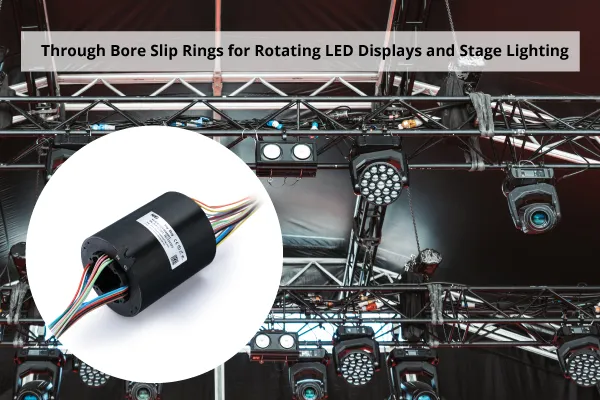
Two of the most striking features at plays and concerts are moving stage lights and rotating LED displays. That effect is the result of a true engineering problem. It maintains high-speed video data, DMX512 control signals, and electricity to an assembly that is constantly spinning without breaking or twisting the wires. Slip rings resolve that issue via a hollow shaft or a through-bore. They are particularly helpful in entertainment systems where both mobility and space-saving integration are crucial, thanks to their hollow center.
What Is a Through Bore Slip Ring?
Hollow-Shaft Architecture Explained
An electromechanical rotary transmission system with an open center bore that permits cables, shafts, pneumatic lines, or mechanical components to flow through the axis of rotation is known as a through-bore or hollow-shaft slip ring. In entertainment systems where drive shafts or cable bundles must share space with the electrical assembly, this design's open center is crucial. Pancake slip rings or solid-shaft capsule rings are not the same as this. The outside diameter and number of circuits can be adjusted to suit the installation's requirements, while the interior bore sizes typically range from 12.7 mm to 300 mm.
How Power and Signals Transfer During Rotation
The rotor's conductive rings rotate and are constantly in contact with a stator, which is a fixed brush block. By reducing corrosion, wear and tear, and electrical noise, gold-gold or silver-silver contact materials help maintain the clarity of DMX512 and Ethernet signals. Typically, electrical noise is kept to a minimum, and variations in contact resistance are limited to 10 mΩ. Conversely, insulation resistance typically ranges from 500 to 1,000 MΩ at 500 VDC.
Why Entertainment Applications Demand Through Bore Slip Rings
The Cable Twist Problem in Continuous-Rotation Fixtures
Aerial equipment, moving-head fixtures, kinetic ring lights, and spinning LED panels must all be able to spin freely in all directions. A basic tethered cable would twist and snap after just a few twists. For moving-head stage lights, the slip ring is integrated into the base or yoke.
This feature enables it to regulate the motor drivers and supply power to the LEDs. The motor shaft can pass through the slip ring's center due to the through-bore design. This saves space in compact housings by eliminating the need for a separate shaft-and-coupling configuration.
Rotating LED Displays: Scale and Complexity
Brushless motors, control electronics, and high-density LED panels are used to operate large rotating LED displays, such as DNA-style columns, architectural signage, and concert stage centerpieces. All of these require steady, silent power and video transmission while they are constantly rotating. Slip rings are used in advertising and event displays to continuously transmit power, picture data, and video signals to revolving LED panels from a stationary control source.
A system may need to be configured in a hybrid manner if it includes multiple DMX512 universes or uses Ethernet-based video protocols, such as Art-Net or sACN. These contain both protected twisted-pair and coaxial signal circuits, as well as dedicated power rings, in a single device.
Theatrical and Live Performance Use Cases
Slip rings are used in Broadway and touring productions to power pixel-mapped lighting arrays and integrated LED strips in revolving turntables and scenery. Lighting components inside spinning machines in aerial performances, such as those found in Cirque-style shows, are powered by bore slip rings.
It prevents any additional, potentially hazardous wires from entering the region. Concert kinetic systems also employ slip rings. These are required for DMX512-compatible kinetic ring lights, such as RGBW fixtures with IP65 housings, to continue working with MADRIX and Art-Net control systems.
Critical Design Specifications for Entertainment Applications
Signal Protocol Compatibility — DMX512, Art-Net, and Ethernet
The DMX512-A employs EIA-485 (RS-485) differential signaling and is based on ANSI E1.11. Accordingly, the slip ring must maintain both signal balance and contact noise below the RS-485 common-mode noise limit. Slip rings with electrical noise levels of 10 mΩ or less are suitable for DMX512 transmission.
Ethernet channels such as 100Base-T and 1000Base-T require circuit design that works best with broadband and gold-on-gold contact technology to reduce packet loss. There are hybrid through-bore designs with high-current power rings capable of handling 10-20 A per ring, Gigabit Ethernet channels, and DMX circuits.
Rotational Speed and Circuit Count
Generally speaking, stage moving heads and kinetic systems run at 30-250 RPM. Through-bore slip rings capable of 250 to 500 RPM are typically more than sufficient for amusement. The quantity of circuits can vary greatly. A large rotating LED display with power, DMX, and Ethernet may require 24 to 48 circuits, whereas a tiny architectural spinning display may require only 6.
With modular through-bore designs, you can alter the bore's size and number of circuits without starting from scratch. Large scenic turntables often have a bore size of over 300 mm, while small moving heads typically have a bore size of 12.7 mm.
Environmental Protection and Mechanical Durability
To keep dust and water jets out, most outdoor performances and festivals require at least IP65 protection. Bore slip rings with IP65 and IP67 certifications are available for sealing.
Fixtures that are exposed to mechanical shock or rigging movement must also withstand strong vibrations. For more demanding setups, you can choose slip rings that meet shock standards similar to those of MIL-STD-810E. The working temperature range of -30°C to +80°C is good for both indoor and outdoor activities.
Contact Material and Service Life
For this kind of work, gold-gold contacts work much better than carbon brush contacts. They can run for tens of millions of revolutions without needing maintenance, make less noise, and leave no conductive waste behind.
With its multi-point fiber technology and precious metals, the brush can last for more than 80 million revolutions. It is very helpful for plays that travel and run on continuous duty cycles.
Also, self-lubricating features mean that factories don't have to schedule lubrication, which makes them run more smoothly.
Installation Considerations for Stage and Display Integrators
Mechanical Integration into Rotating Assemblies
The slip ring slides onto the rotating shaft in a through-bore setup. Before tightening the clamping screws, make sure they are centered. It will keep the load even and the brush from wearing out too quickly. To keep the stationary brush block from spinning with the rotor, you need to use an anti-rotation plate or locking rod to hold the stator housing in place.
A common mistake can completely lose the signal. If motor cables, pneumatic lines, or additional data cables pass through the hollow bore, the bend radius at the exit point must be carefully controlled to avoid fatigue.
Electrical Wiring and Signal Shielding
The color-coded lead wires on the stator and rotor sides make it easier to wire the field. This feature also reduces the likelihood of circuits getting mixed up when putting together quick touring rigs.
Shielded twisted-pair cable should run from the bore exit to the downstream distribution system for Ethernet and other high-speed data circuits. Even with the slip ring, external shielding is still needed.
When sizing the power ring, consider the LED panel's total load, the motor driver's load, and the control electronics' overhead. You should leave about 20–30% of the power ring's capacity free for thermal headroom.
Maintenance and Inspection in Production Environments
Through-bore designs usually make it easier to get to brush block assemblies than capsule forms. This makes checking in between touring legs easier.
Before the show, make sure the anti-rotation hardware is tight, look for wear debris on the contacts, and use a milliohm meter to measure the contact resistance for systems that have a lot of work to do.
Selecting the Right Through Bore Slip Ring for Your Application
Key Parameters to Specify
Before getting a unit, engineers should fill out a detailed specification checklist:
● The inner diameter of the bore is the outer diameter plus the space between the shaft or cable bundle.
● The number of coax channels, power circuits, and signal/data circuits
● With derating, the voltage and current of each ring
● Need for the highest RPM
● Coax video, Ethernet, RS-485, and DMX512 are all signal protocols.
● IP protection class
● Operating temperature range
● Anticipated lifespan in terms of total revolutions or usage hours
Off-the-Shelf vs. Custom Solutions
The modular through-bore series features circuit counts from 6 to 48 and bore sizes from 12.7 mm to 100 mm. From tiny moving heads to massive scenic turntables, they can be employed for a variety of entertainment applications.
Custom solutions are required when the bore is larger than 300 mm, when Ethernet, coax, and hybrid power lines must all fit into a single tiny body, or when unusual IP or temperature certifications are required for unique outdoor installations.
Conclusion
Some of the most spectacular visual effects in contemporary entertainment, such as rotating LED columns at festivals and rotating aerial rigs in stage productions, are subtly supported by bore slip rings. Their hollow center, ability to carry data and power, low-noise precious-metal contacts, and ability to be produced with varying bore and circuit sizes make them ideal for these systems. For the application to function successfully for a long time, the electrical and mechanical duty cycle must be carefully set from the beginning.
NBG Innovations Group Pte.Ltd.
#13-13A, International Plaza, 10 Anson Road, Singapore (079903)


Navigation
 HomeSustainable
Product