


Why Precious Metal Contacts Matter in Signal Transmission
BY NBG
 2026-08-04
VIEWS: 2471

Why Precious Metal Contacts Matter in Signal Transmission?
Contact resistance signal integrity is not a problem that shouts for attention. At the point of contact, the signal quality can be retained or lost, and the metal at that junction dictates which way it goes. Low voltage signals will either pass cleanly or arrive corrupted, depending on the chemistry and tribology of that surface, what it is made of, how it reacts to its environment, and how it holds up under continuous sliding.
The Contact Interface Problem: Why Base Metals Fail
Base metals are the foundation of electrical systems for good reason: cost, availability, and conductivity. But their surface behavior works against them at sliding and low-energy interfaces in ways that build up slowly and compound over time.
Oxide Layer Formation and Contact Resistance
Formation of oxide layer and contact resistance. Copper, tin, and nickel are the workhorses of electrical systems, and their limitations are most apparent at the contact surface. All these metals will readily oxidize upon contact with air, moisture, and contaminants in an industrial environment. The oxide films that form are electrically resistive, creating an insulating barrier where the current must cross from one conductor to another. In low-voltage dry-circuit applications, at voltages below 1 V and currents below 100 mA, the available energy from a contact closure is insufficient to rupture these films. Signal attenuation, intermittent transmission, or complete blockage occurs.
Fretting Corrosion
Fretting corrosion of electrical contacts is one of the least seen and most damaging failure modes in precision systems. Micro-motion at contact interfaces, caused by vibration, thermal cycling, or the constant rotation in slip ring assemblies, scrapes the clean metal surface over and over, exposing fresh metal to oxidation with every micro-displacement. The debris this process creates is both abrasive and electrically resistive. Each fretting cycle degrades the surface condition for the next. The failure is slow and usually silent until the signal degradation reaches a threshold that triggers a system alarm or sensor dropout.
What Makes Precious Metals Different? The Physical and Chemical Basis
The contact behavior of noble metals is due to basic electrochemistry, not to processing or surface treatment alone.
Chemical Stability Under Electrical Stress
The unique feature of noble metals in contact applications is chemical inertness under electrical stress. Gold, platinum, and palladium have no surface oxide or sulfide films under normal operating conditions. Gold, unlike tin, does not react with sulfur compounds present in industrial or outdoor environments under any normal conditions. Silver forms a resistive silver sulfide. Tin turns to tin oxide. Gold forms nothing. And it is this lack of surface film that is exactly why gold contacts in slip ring applications are the engineering standard for dry circuit and signal-level contacts.
Electrical Conductivity Profile of Each Metal
Silver boasts the highest electrical conductivity of all metals, ~106% IACS (IACS is a relative measure of conductivity compared to copper), and is the material of choice for high current power paths where conductivity is the primary requirement.
Gold contact materials are somewhat less conductive than silver, with a resistivity of about 2.44 μω ·cm. Still, they provide stable, low contact resistance performance over a wide temperature range and in corrosive environments that silver cannot match.
Palladium is harder and more wear-resistant than gold. It also has excellent corrosion resistance and thermal cycling stability. It is the material of choice for high-cycle count applications where mechanical wear is the dominant failure mode.
Palladium-nickel alloy goes even further, providing a practical engineering compromise for a harder surface, strong corrosion resistance, and good conductivity for applications where both wear and signal integrity must be managed simultaneously.
Why Slightly Less Conductive Doesn't Matter at the Signal Level
When voltage and current are low, resistance stability over the service life is more important than peak conductivity at installation. A gold contact slip ring system that maintains ten milliohms after ten million cycles provides more to the application than a silver contact that opened at eight milliohms and topped out over two hundred after sulfidation set in. The initial advantage of silver in conductivity is lost due to the surface chemistry that follows in sulfur-bearing environments.
Precious Metals in Slip Ring Contacts: Engineering Specifics
Slip rings impose contact-material demands that most static connector applications will never encounter, and the logic of material selection reflects that disparity.
The Sliding Contact Challenge
The brush is always riding on a rotating ring track. That motion generates wear debris, friction heat, and micro-vibration throughout its life. In base-metal contact systems, these conditions accelerate oxidation and surface degradation. Precious metal pairings resist those mechanisms, but the brush material and the ring-track surface need to be matched correctly. A poorly chosen pairing can completely negate the material advantage.
Gold on Gold Contact Systems
For precision signal transmission in slip ring applications, gold contacts are the industry standard. Gold to gold pairing provides low electrical noise for high-speed fieldbus, Ethernet, analog sensor signals, and video transmission. Gold has a low coefficient of friction, which means less contact force is needed to achieve a good connection, reducing wear and tear on both the brush and the ring over time. In gold alloy systems, a thin film of contact-grade lubricant is usually applied to control the brittleness developed at the sliding interface.
Fiber Brush Technology with Precious Metal Coatings
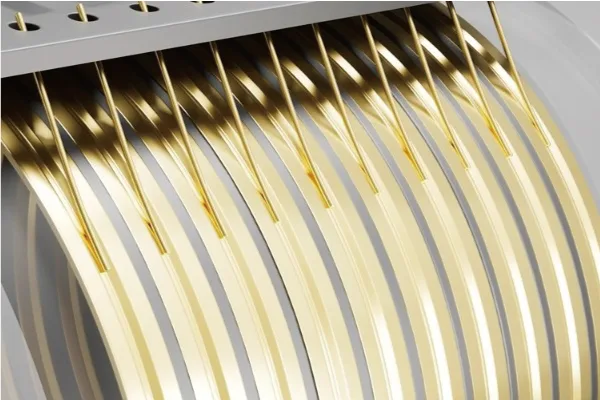
Multi-wire and multi fiber brush designs distribute the contact load across multiple redundant points. If one wire hits debris or a worn spot, the adjacent contacts still keep the circuit. The wire material is a precious metal alloy, gold, gold-cobalt, or palladium, spot-welded to beryllium copper spring bases that provide the interface with mechanical resilience. It is a design commonly used in capsule slip rings for robotics, medical imaging equipment, and UAV gimbal platforms.
Palladium Nickel as a High Cycle Alternative
Pure gold tends to develop prow-formation wear over tens of millions of rotational cycles, in which debris accumulates at the contact point and disrupts the interfacial geometry. Palladium-nickel coatings are harder than gold electrodeposits, can handle that wear regime without the same debris buildup, and retain the conductivity required by signal-grade circuits.
Application Contexts Where Contact Material Is Non Negotiable
Some applications cannot tolerate resistance drift, and in those environments, the choice of material is driven by what the system cannot afford to lose.
Medical Imaging Systems (CT, C-Arm, PET)
CT gantries continuously rotate at speed whilst carrying multi-channel power and high-speed digital data. Any signal loss or noise during a scan is clinically unacceptable. Choosing the contact material in medical imaging is a patient safety issue that should be addressed from the very first stage of specification, not a procurement variable addressed at the end.
Aerospace, Defense, and Radar Systems
Avionics and satellite connectors operate in a vacuum, humidity, and persistent vibration from -55 to +125 degrees Celsius. Hard gold plating provides contact resistance of less than 50 milliohms and permits data rates exceeding 10 Gbps after prolonged environmental exposure. Military rotary systems, such as radar antennas and electro-optical/infrared gimbal turrets, require contact materials that do not require scheduled maintenance between operational periods to maintain specifications.
Industrial Automation, Robotics, and Wind Energy
Robot wrist axes, AMR joint slip rings, and wind turbine pitch and yaw systems transmit digital fieldbus and sensor signals via continuous rotation in non-clean, non-temperature-stable environments. Palladium nickel and gold cobalt alloys are the choice over pure gold contacts for high cycle counts and rough conditions.
Instrumentation and High Precision Sensors
Rotary encoders, potentiometer sensors, and throttle position sensors are designed to transmit millivolt level signals via precious metal spring contacts. Direct corruption of the sensor output due to oxidation-induced contact resistance drift. This results in incorrect readings and false alarms, and the contact surface is normally the last place where the fault is found because the failure first appears as a signal or software problem.
Gold vs. Silver vs. Palladium: Engineering Selection Framework
Four considerations determine the material selection: the voltage level, the current magnitude, the number of cycles, and the chemical environment of the contact.
Decision Criteria at a Glance
Parameter | Gold | Silver | Palladium / Pd-Ni |
Corrosion Resistance | Excellent | Moderate (sulfidation risk) | Excellent |
Contact Resistance Stability | Best for low-voltage signals | Best initial; degrades | Good; stable under cycling |
Wear Resistance | Moderate (alloys improve this) | Low | High |
Best Application | Dry circuit, signal-level, low-voltage | High-current power paths | High-cycle, mixed-duty |
Cost | High | Moderate | Moderate–High |
Critical Compatibility Rule
Never mate gold contacts with tin contacts. In galvanic corrosion, tin migrates to the gold surface, eventually forming a layer of tin oxide that impedes signal flow and cannot be restored without replacement. Gold to gold pairing is recommended for long-life, low-noise signal contacts.
Plating Thickness and Alloy Selection
Standard specifications for signal-only contacts cover 0.5 to 1.25 micrometers of hard gold (gold cobalt or gold nickel alloy) over a nickel diffusion barrier. Thicker gold deposits do not always mean better performance; overly thick gold can lead to contact voltage drop in precision circuits. Controlled deposition and alloy composition are required, not afterthoughts.
Cost vs. Reliability
There is a real upfront material cost for the gold and palladium contacts. The value of that premium depends on the actual cost of a contact failure in the application.
Lifecycle Cost Over Upfront Material Cost
The premium for gold or palladium contacts is recouped through reduced downtime, longer service intervals, and avoided system failures during the equipment's operating life. In critical medical, aerospace, and defense applications, the cost of just one contact-related failure, including labor, downtime, and liability impacts, is many times the incremental cost of a precious-metal specification.
Selective Application
You do not have to cover the whole component with precious metal. To minimize total material cost, it is better to plate only the contact surface, with the structural load supported by copper or a copper alloy to achieve full performance at the interface.
Conclusion
Signal integrity, stable contact resistance, and long service life must coexist when precious-metal contacts are an engineering necessity. Gold, silver contact materials, palladium connector plating, and their alloys are chosen based on voltage level, current magnitude, number of cycles, environmental exposure, and maintenance accessibility. The contact material is a key factor in the ability of slip rings and rotating interfaces to meet the system's design life without resistance drift or surface breakdown.
NBG Innovations Group Pte.Ltd.
#13-13A, International Plaza, 10 Anson Road, Singapore (079903)


Navigation
 HomeSustainable
Product